Another stretch where I just couldn’t get to the blog. I have been preparing for some conferences. This Friday is a Public Archaeology Twitter Conference. I will be the last presenter of the day, at 23.15 GMT presenting the paper “Preserving Aviation Archaeology Sites While Engaging Public Interest: A Discussion with Gander, Newfoundland, as a Case Study”. If you want to follow the conference, check out #PATC and for my paper discussion, follow me at @planecrashgirl. This should be an interesting experiment in conference presentations, and a wonderful way to make academic papers more accessible.

Time for a book review.

A wonderful friend of mine gave me one of the most amazing gifts I have ever received: a well-loved copy of Charles A. Lindbergh’s “We”: The Famous Flier’s Own Story of his Life and his Transatlantic Flight, Together with his Views on the Future of Aviation. When he gave it to me, he called it his prized possession and wanted me to have it. Thinking about how much this gift means continues to make me a little emotional to know that I have such amazing support in my research. Thank you Nelson.

I know there is very little about Newfoundland in this book, but Lindbergh does mention Newfoundland and flying over on his historic trans-Atlantic flight. Plus, he did visit Newfoundland a few times on his flights, or at least fly over.

“We” is a very interesting read from the perspective of aviation history. Lindbergh is not a strong writer, in fact, he feels that he is at a loss for words when it comes to talking about the celebrations and fanfare surrounding his trans-Atlantic flight and brings in Fitzhugh Green to write about the speeches and fanfare.

From Lindbergh 1928

Throughout Lindbergh’s book, the focus is so much more on his early flying career; his training, barnstorming, and his time training for the reserves. He devotes very little to the planning and preparation of his trans-Atlantic flight. In fact, if you were to read it without Green’s section, it almost seems like the flight is a bit of a whim instead of months of planning. Certainly, he talks about how he changed the aircraft to carry more fuel, some of the testing, and his route planning, but it is all done in very little details when compared to his stories about barnstorming or his crashes and accidents.

From Lindbergh 1928

What Lindbergh’s book is really interesting for is his descriptions of early flight training, and the novelty of aircraft in different areas of the United States. He spends a lot of time barnstorming and working fair circuits to make some money, and has some great stories where people come together around the novelty of aircraft (communities pitching in to allow a coloured individual to fly, pulling the aircraft out of a ditch, or even forgiving damages to a storefront as it would be great advertising for the shop!). He talks more about his first plane (a military auction Jenny) than the other half of we in “We” (Spirit of St. Louis).

From Lindbergh 1928

What is of particular interest for any aviation historian is his in-depth look at training to be in the Army Air Corps Reserves. He devotes a lot of the text to the ins and outs of training, the trouble they sometimes got up to, and has his one accident report copied verbatim.

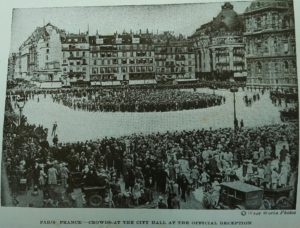
Lindbergh offers up insights and theories on aviation, many of which came to be in the next few years, such as the importance of parachutes and the capabilities of aircraft. He continuously refers to the short period of invention to improvement of aircraft and envisions almost limitless journeys in all kinds of weather. While flying at night and in poor weather has much improved, there are of course still the weather extremes that can stop flights. But, as Lindbergh predicted, these are always improving (see YYT and their new measures to help flying in the fog). The only one I think he really missed the mark on was discussing commercial aviation, but then, he talks about the potential for commercial aviation with small aircraft in mind, and for many years, commercial aviation was incredibly viable as a luxury venture with small aircraft. Now, with the larger aircraft, and discounted rates, it seems to be a whole different creature than what could be envisioned with the small aircraft of the 1920s.
From Lindbergh 1928

Sources

Lindbergh, C.A.
1928 “We”: The Famous Flier’s Own Story of his Life and his Transatlantic Flight, Together with his Views on the Future of Aviation. Grosset & Dunlap Publishers: New York.

From Lindbergh 1928

Of all the sites I researched for my thesis, this one offered the most challenges. It was the most difficult to research, the most difficult to access, and when we got there, the most difficult to map and photograph.

It wasn’t helped by it being an overcast day and the GPS not able to find enough satellite data. Photo by Lisa M. Daly 2010.

The site is located behind the airport, south-east of runway 2 (13/31 degrees or 12/30 during the war era, Tibbo 1997). It is on the edge of a large bog, and I tried to access it from a few different routes. In 2010, trying to take a direct path across the bog, I ended up falling in up to my chest and had a lot of difficulty getting out. I certainly didn’t want to risk my assistant falling in, especially seeing as up to my chest would have been over her head! A second attempt had us skirt the bog in an attempt to get to it that way. In this case, we came to a river. It was pretty fast-flowing, so not easy to just cross. So, one assistant attempted to make us a small bridge with some deadfall to make crossing easier. He fell in and got absolutely covered in river muck. It was a cold day, so I thought it best to try again later. Over the rest of 2010 we reached other sites and recorded those, and the B-25 found itself left for another year.

The river that took out one of my assistants in a 2010 attempt to reach the site. Photo by Lisa M. Daly 2010.

In 2011 I had a different team, and it was a much hotter July. So if we got wet, we’d dry relatively quickly and not have to worry about being wet and cold for hours while trying to work (have to put the health and safety of my team first, of course). It also helped that between 2010 and 2011, GoogleEarth had updated and had better images, so we found what looked to be an old, overgrown, road that should take us somewhat close to the site. Turns out, we couldn’t find a road, but there was a river that took us most of the way, so we hiked up our packs and portaged the survey equipment down the river. With a great team who weren’t afraid to get lost in the woods, we found the site.

The edge of trees from the bog. Aircraft debris was found in both the bog and the trees. Photo by Lisa M. Daly 2011.

Royal Air Force records are not easy to come by. Many of the ones related to specific aircraft were destroyed, and the personnel records (how I found information about the Hudson near the Commonwealth War Graves) can only be accessed by the individual or a descendant. Some websites claim to have the records, but won’t show anything until you pay them. So, that leaves me with online forums and Ocean Bridge by Christie (1995).

What is known is that RAF B-25 Mitchell KJ584 crashed during a night takeoff from Gander on 29 August 1944 at 0342 GMT (Christie 1995; RAF Forum 2012). All crew on board were killed in the crash.

Aircraft debris. Note, the machete visible in these pictures is there for scale (we forgot our scale). Photo by Lisa M. Daly 2011.


Name Rank Service Seat
Kabin, Vladimir John  Captain RAF Transport Command Pilot
Flood, David Sgt. RAF #1550839 Navigator
Sheldrick, Thomas Tweed Sgt. RAF #1311000 Radio Operator

Crew of B-25 Mitchell KJ584, adapted from Christie (1995). Christie has Kabin listed as a Canadian civilian, but according to the RAF Forum and the NBG site, Kabin was RAF Transport Command, meaning he was a civilian who was ferrying aircraft overseas before the RAF took over.

Debris found in the bog showed significant deterioration, possibly due to the rise and fall of the bog during wet and dry periods. Photo by Lisa M. Daly 2011.

From an archaeological perspective, the site offered challenges because unlike the RCAF Lodestar, it wasn’t just on the edge of a bog. It was actually partially in the bog and partially out. In fact, the wet area seemed more like it was a relatively new wet area as it might have been an expansion of the bog after the area had been logged. The pieces scattered around the open area could be easily measured, both by a Garmin GPS or by the surveryor’s level. However, I opted to not use the surveyor’s level because what was in the trees could not be measured that way. Debris was scattered throughout the tightly packed grove of trees, and sometimes larger pieces could not be properly photographed because other trees were in the way.

A segment of fuselage that could not be properly photographed due to the trees. Photo by Lisa M. Daly 2011.

The site itself was well recovered, most likely at the time of the crash. There were no propellers, instruments or other sensitive equipment on site. Most of what could be found were aluminum fragments of the fuselage and some pieces of the frame. The engines had been left on site, but were recovered by 9 Wing Gander a few years previous and laid closer to the road leading to Deadman’s Pond. According to Frank Tibbo (pers. comm. 2011), there were to be (or will be) used by the North Atlantic Aviation Museum.

Engines found near the road to Deadman’s Pond. Photo by Lisa M. Daly 2011.

Given that in looking around the site there was no evidence of an entry point of the aircraft, and that much of the debris in the trees did little damage to said trees, it is highly likely that there was a mid-air explosion which scattered the aircraft around the site. There is no evidence of burning, like at the USAAF B-17 44-6344, and no birch trees which would grow first after a fire, as seen at the RCAF Canso 98107. There are no real markers of visitation to the site, usually in the form of graffiti or litter, but I have talked to people who have been at the site, and who claimed to have removed things from the site (although their story changed and I cannot confirm exactly from which site they visited and removed material).

This section is wrapped around a tree stump, but laid against others, suggesting it may have fallen into the trees. Photo by Lisa M. Daly 2011.

This site offered many challenges, but hopefully if I could ever have access to the personnel records there would be more information and it could give a better idea as to what happened in this incident.

Sources:

Christie, C. A.
1995    Ocean Bridge: The History of RAF Ferry Command. University of Toronto Press, Toronto.

Newfoundland’s Grand Banks (NGB)
2007    Mount Pleasant Cemetery – St. John’s: Field of Honour. (accessed 21 Mar 2017).

RAF Commands Forums
2014    Thread: 440829 – Unaccounted Airwomen & Airmen – 29-8-1944 (accessed 21 Mar 2017).
2011    Thread: Ferry Command Crash Sites in Gander, Newfoundland. (accessed 20 Mar 2017).

Tibbo, F.
2011    Personal Communication
1997    The Best of Aviation: 101 Tales of Fliers and Flying as Published in The Gander Beacon. Creative Book Publishing, St. John’s.

Debris from the wreck of RAF B-25 KJ584. Photo by Lisa M. Daly 2011.