Recently I had an opportunity to visit Florida. While I researched and found a number of military and aviation museums around the state, I did not have the opportunity to visit many of them. In fact, I only visited the one museum, the Armed Forces History Museum in Largo, Florida.

Entrance to the Armed Forces Military Museum in Largo, Florida. Photo by Lisa M. Daly, 2016

This museum did not have a concentrated look at one area of history or one branch of the armed forces, but rather had a greater focus on looking at many of the armed conflicts the United States has been involved in since the First World War. Many part of this museum were wonderfully immersive, from wandering through the trenches of the First World War, to standing around models of the ships attacked at Pearl Harbour with a projection of planes flying on the day of the attack, to resisting the urge to swat at mosquitos while walking through a Vietnam swamp. The displays are wonderfully done, and done with a passion that is not always seen in museum setups.

First World War trench recreation, complete with soldiers and attacking aircraft. Photos by Lisa M. Daly, 2016

As a Canadian, the strong American patriotism is something a little foreign, but I believe that seeing it in action in this museum has given me a better understanding of how I can shape my own work to better suit how many Americans feel the USAAF should be memorialized. In fact, the monuments that I saw while travelling around Florida gave a different perspective when compared to the small war memorials that can be found in every community in Newfoundland. I found many of the monuments in Florida were much grander, and many of them were also much newer than those erected after the First World War here.

Monument in Largo Central Park. Photo by Lisa M. Daly, 2016

From a research perspective, I very much enjoyed the exhibits that showed the kit bags used by Second World War airmen. In particular, the exhibit featured the uniform and kit of a B-24 Tuskegee airman. Such  exhibits help me a great deal, especially when thinking of site visits where personal effects and parts of kits have been found. I will be sure to use the photographs I took for future reference.

A very detailed exhibit on the Tuskegee Airmen, and a visualisation of much of the equipment found on a B-24. Photos by Lisa M. Daly, 2016

As for the history enthusiast in me, I very much enjoyed the room featuring uniforms from across the Armed Forces and across the years. I showed the evolution of many of the uniforms, and the changing roles of women within the Armed Forces. As well, as someone who has watched M*A*S*H quite a bit, their detailed section of the Korean War was nice to see. It is often a conflict neglected in military museums, but this museum very much showcased it, and I learned that Rosie’s Bar was based on an actual place (to make my geeking out over M*A*S*H complete, I found a candy store that sold Grape Nehis!).

Rose’s Bar, which became Rosie’s Bar and was heavily featured in M*A*S*H. I had no idea it was based on an actual bar. Photo by Lisa M. Daly, 2016

There are other activities that are available for additional fees, such as simulators and the opportunity to ride in a WWII M8 Reconnaissance Vehicle. But before you try to visit, check the website. Sadly, I would like to recommend this museum to anyone in the Largo/Clearwater Region, but the museum’s main benefactor recently passed away, and although this is a world-class museum (in my opinion) it is not sustainable if running solely on admissions. Therefore, the museum is currently in the process of closing. I am grateful for the opportunity to have visited the Armed Forces Museum in Largo, and while I did not get to any of the better known facilities, am happy I visited this one before it closed.

Outside the museum. Photos by Shannon K. Green and Lisa M. Daly, 2016

If you are in the St. Petersburg region, I would highly recommend visiting The Hangar restaurant. It overlooks Albert Whitted Airport, a small, active airport. While having a delicious burger, I had the opportunity to watch what I can only assume was a new pilot practicing takeoff and landing. It was a wonderful experience, and made for a great afternoon (plus the food, beer and service were wonderful!). If I get to go back again, I will see about contacting the Albert Whitted Airport Preservation Society about a tour.

Enjoying at afternoon of airplane, good food and beer. Photos by Lisa M. Daly, 2016

Time to get back to some regular posts. I think it is fair to say that my summers and falls get very busy, and it does become very difficult to find the time to research and write posts. For the most part this is done in my free time, but there are times where there is overlap with paid work (such as coming across memories of the Hindenburg being seen over Logy Bay-Middle Cove-Outer Cove), and trying to find more information about the 1956 crash which hit a home in the area (still working on getting the crash report for that site).

Now that the tourism season has ended, and my contract at the museum is up, it’s time to turn back to research. In October, I was asked to do an archaeological-style survey of a site for the town of Portugal Cove-St. Philip’s. The town has kindly allowed me to share my findings with my readers.

Most site visitors will come across this piece of engine cowling first when approaching the site. Photo by Shannon K. Green 2016

Most site visitors will come across this piece of engine cowling first when approaching the site. Photo by Shannon K. Green 2016

At 9am on Friday, 23 June 1978, a Gander Aviation Ltd. Beechcraft 80 took off from Torbay Airport en route to St. Anthony. This aircraft was one of three carrying members of the National Historical Sites and Monuments Board and local officials who were to attend a ceremony in L’Anse aux Meadows. Included on this flight was William (Bill) Manning, the mayor of Torbay and the area superintendent of Historic Sites of Newfoundland and Labrador. Soon after departure, the aircraft informed the airport that it was at 165m and climbing to 1900m. Moments later, the emergency locator transmitter activated, indicating a crash. Locating the crash was hampered by thick fog in the area, and the crash was located by a search and rescue helicopter at 11:45am. According to Captain Walter Chipchase of Halifax Search and Rescue, search and rescue efforts were hampered by thick fog. Paratroopers could not be immediately dropped on site due to the thick fog and zero visibility conditions. Search and rescue had to wait until the fog lifted before they could land the helicopter and reach the site.

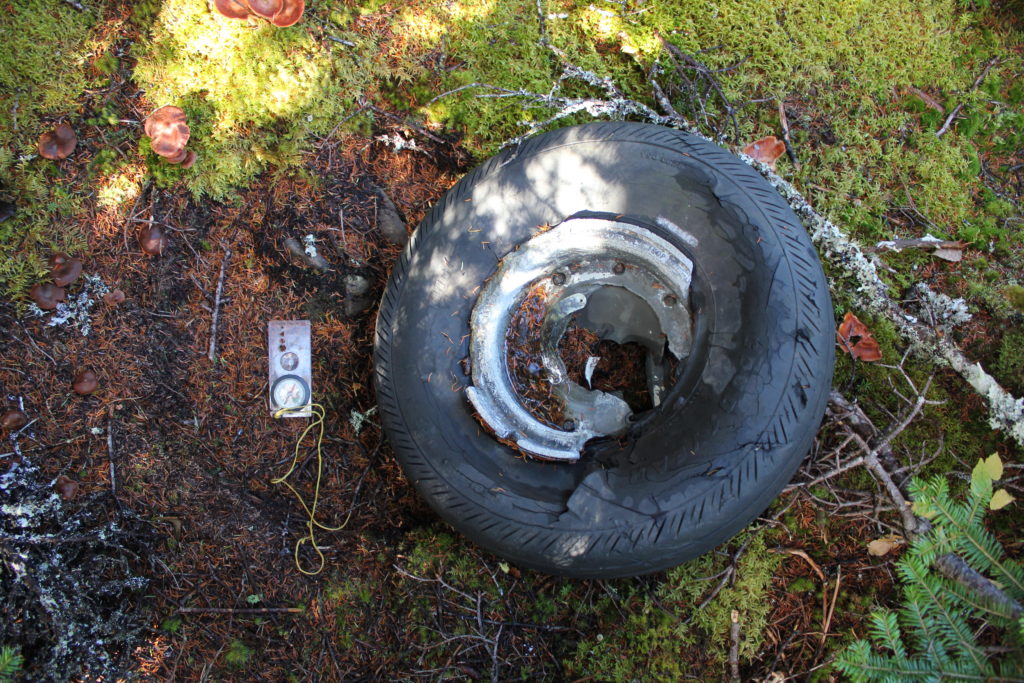
Nose wheel. Photo by Shannon K. Green 2016

Nose wheel. Photo by Shannon K. Green 2016

All ten crew and passengers were killed in the crash. On board were pilot Gerald Eichel and co-pilot Michael Fitzpatrick, both of Gander, Signal Hill Park superintendent and Torbay Mayor, Bill Manning, national board chairman Marc Laterreur of Quebec, Ontario board member B. Napier Simpson Jr., Manitoba board member Robert Painchaud, New Brunswick board member Jules Leger and his wife, Jacqueline, and board assistant secretary Brenda Babbits and her husband, Alex.

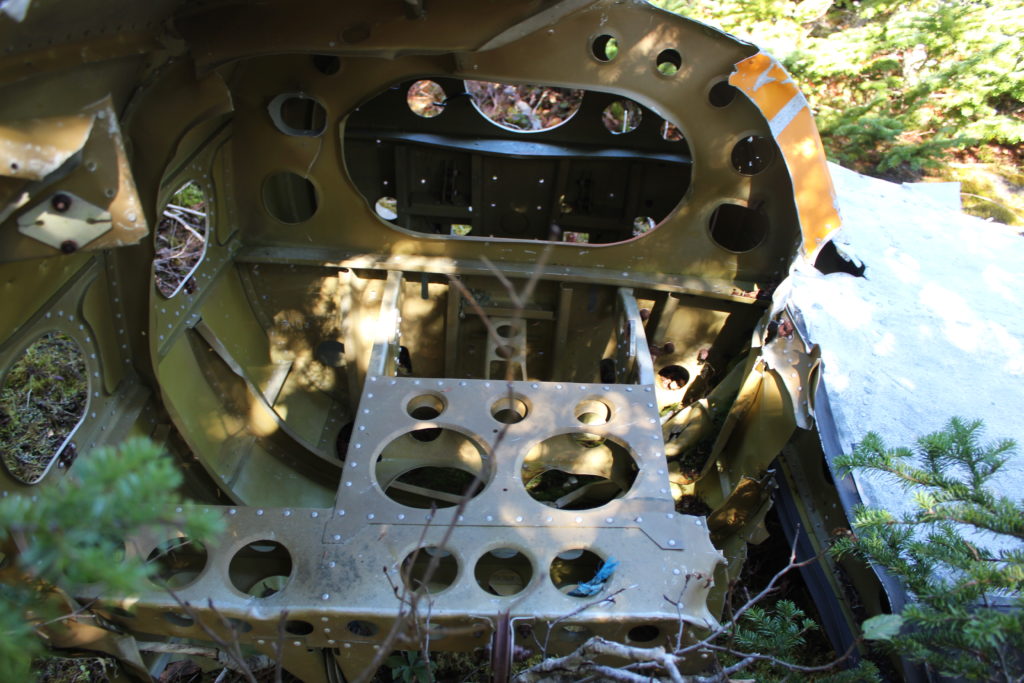
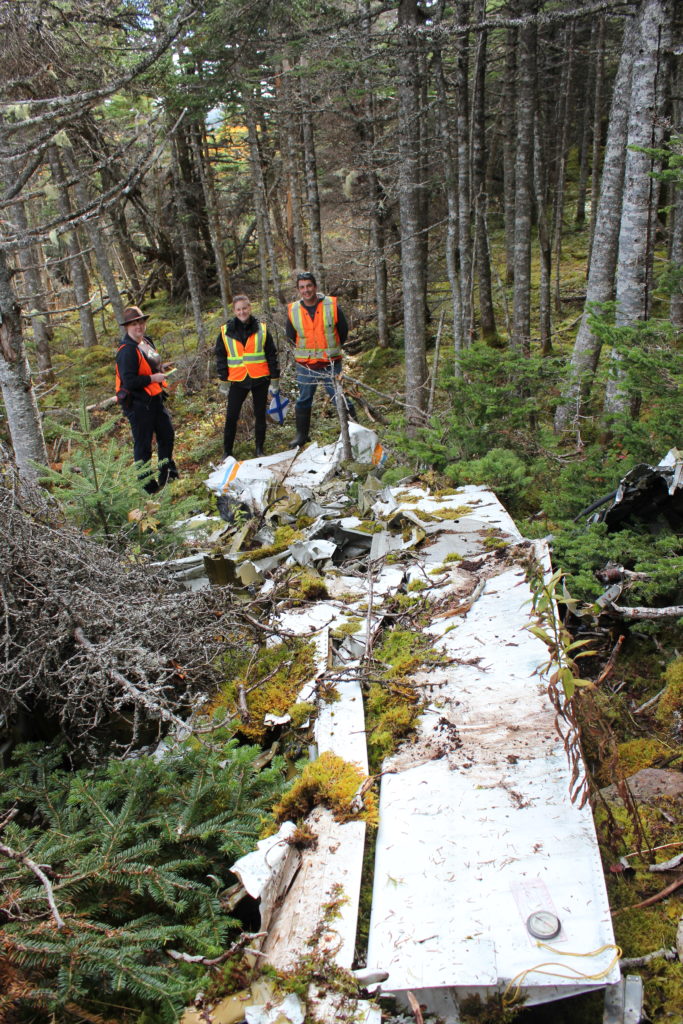
Inside a section of aircraft, Photo by Shannon K. Green 2016.

Inside a section of aircraft, Photo by Shannon K. Green 2016.

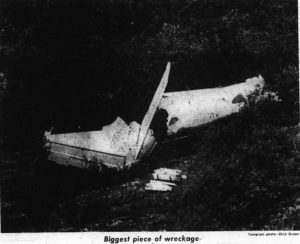
Investigations continued for a number of weeks, and wreckage was recovered from the site. According to Chipchase, the aircraft was on its flightpath at the time of the crash, but many rumours suggested that the aircraft was turning around to return to the airport. Newspapers at the time reported that the aircraft had turned around in the fog and was returning to the airport before the crash happened. This story has become the most commonly mentioned cause of the crash. It is dominantly based on photographs shared by the newspapers which stated that the tail indicated that the aircraft was returning to the airport. Owner and operator of Gander Aviation Ltd., Bill Bennett, contacted the Evening Telegram in an attempt to dispel these rumours, but they persisted in the media coverage. According to Bennett, the pilot, Gerald Eichel, had a year and a half experience, 622 hours flying Beechcraft and 4900 hours total flying time.

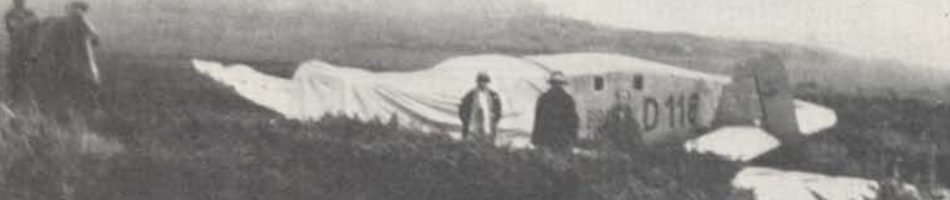
Image of the tail section as published by The Evening Telegram in 1978.

Image of the tail section as published by The Evening Telegram in 1978.

There has been some debate as to the cause of the crash. The accident report was not available at the time of this project (even in 2003 when the local newspaper, The Telegram, went looking for the article they were told that due to the changes that had happened to the various organizations responsible for safety and aviation it was a difficult document to find), and from the time of the incident there were varying reports. In fact, after investigating the site, there is little evidence to suggest that the pilot decided to turn around (without informing the airport) as all of the aircraft is concentrated on the airport side of the ridge. The fact that the tail of the aircraft was turned in the other direction does not indicate that the aircraft turned around as during a crash sections of the aircraft can turn in any direction due to the force of the impact.

The view from the ridge overlooking the wreckage. Photo by Lisa M. Daly 2016.

The view from the ridge overlooking the wreckage. Photo by Lisa M. Daly 2016.

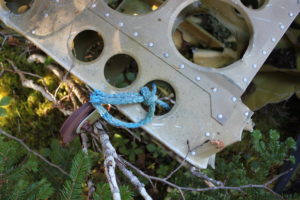
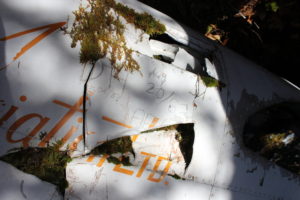
This site is relatively well-protected as it is only accessible through private land. The land-owner is very protective of the site, and tries to limit access to anyone who might damage the remains of the aircraft. We were granted access only after ensuring we were not going to remove anything from the site, and were recording the site for future reference and preservation of the site as a memorial to those who were lost. Even with this, there has been damage to the site over the years. There is some graffiti on the largest piece of fuselage, most of which dates to the early 1980s. The tail has also been further damaged than what can be seen in the 1978 The Evening Telegram photograph. As well, rope was tied around part of the tail (the rope has since been removed, don’t want to make it easy for anyone to remove items) possibly indicating that someone attempted to pull it away from the site.

img_5681

Evidence of site damage. Photos by Shannon K. Green 2016

Evidence of site damage. Photos by Shannon K. Green 2016

The 40th anniversary of this crash will be in 2018. The town of Portugal Cove-St. Philip’s plans to memorialize this site for that anniversary. This investigation was an early step in the memorialization and preservation of this site to honour the ten souls lost in this incident.

Lisa Daly with Julie Pomeroy and Gary Picco of the town of Portugal Cove- St. Philips. PHoto by Shannon K. Green 2016

Lisa Daly with Julie Pomeroy and Gary Picco of the town of Portugal Cove- St. Philips. PHoto by Shannon K. Green 2016

Sources

Agnew, D.
1978      No Survivors as Place Crashes Near City. The Evening Telegram, 99(71):1. One file at A.C. Hunter Library.

Aviation Safety Network
2016      ASN Wikibase Occurrence #31576. https://aviation-safety.net/wikibase/wiki.php?id=31576 [accessed 25 October 2016].

Callahan, B.
2003     Leslie Harris Recalls Leaving Doomed Plane. The Telegram, 124(355). On file at A.C. Hunter Library.

Daly, L.M.
2016     Survey of the 1978 Beechcraft Crash Site Near Bauline Line. On file at the Town of Portugal Cove-St. Philip’s.

Hillier, D.
2016      Personal communication

Unknown
1978      Crashed Aircraft’s Owner Says Remark is Misleading. The Evening Telegram. On file at A.C. Hunter Library.

Unknown
1978      8 Prominent Historians Died in Plane Crash. The Evening Telegram. On file at A.C. Hunter Library.

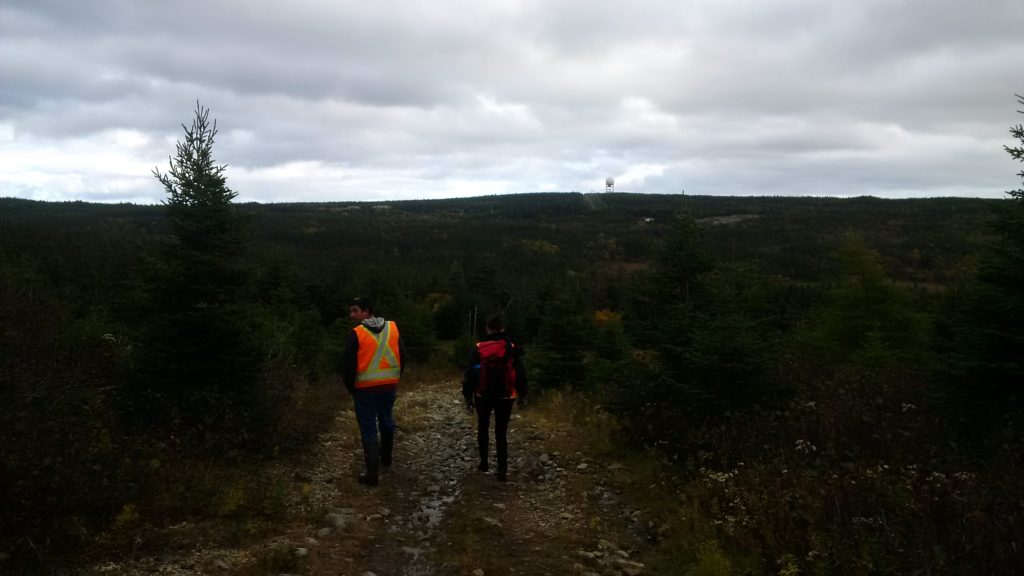
Walking back from the site with Torbay Airport visible in the distance. Photo by Lisa M. Daly 2016

Walking back from the site with Torbay Airport visible in the distance. Photo by Lisa M. Daly 2016