Gander

All posts tagged Gander

Sorry about the double posting from my old blog. I was a little wrapped up transcribing the records of First World War Newfoundland servicemen for the Trail of the Caribou, and trying to get ready for Sci-Fi on the Rock. Very different, I know, but I did represent dieselpunk at the Steampunk Newfoundland presentation about different branches of steampunk.
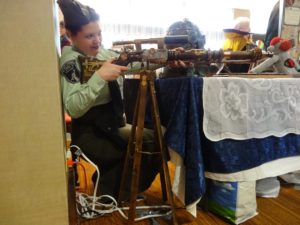
Dressed in dieselpunk, playing with the props at the Steampunk NL table at SFotR. Photo by Brent Slade.

Dressed in dieselpunk, playing with the steampunk gun made by FoamWerx Cosplay at the Steampunk NL table at SFotR. Photo by Brent Slade.

Anyway, I finished reading Mr. Cooper’s book a few weeks ago, but was really trying to figure out how to write a review of it. Tales from a Pilot’s Logbook by Royal Cooper is a fascinating read, and in a different way from many of the other books that are available. There are always official histories and memoirs written by decision makers, but often some of the most informative works are those by the average pilot. Cooper certainly paints himself as an average pilot, but with all of the adventures, near misses, and events in his career as a pilot, it makes a reader wonder what being an average pilot really means.

Cooper frames his book with his early brush with aviation, seeing Italo Balbo’s Italian Air Armada land in Shoal Harbour in 1933. In fact, it is an image of the Armada which he says looked like a “swarm of bees” approaching Shoal Harbour. This incident awaked the passion so often found in pilots, and gave Cooper the inspiration to be an aviation while the need for pilots in the Second World War gave him the opportunity. He uses an image of the aircraft to end every chapter, which consistently reminds the reader how a young boy in Shoal Harbour fell in love with aviation and kept that memory throughout his career.

Not the image used by Cooper, but one available at The Rooms. [Item A 57-149]
Not the image used by Cooper, but one available at The Rooms. [Item A 57-149]

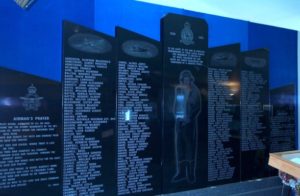
Cooper’s career began with the 125 (Nfld) Squadron in the Royal Air Force. While I won’t go into details, he tells of exciting flights, near misses, and his run-ins with the enemy. What struck me the most was how Newfoundlanders are Newfoundlanders no matter where they are. Each person from the 125 (Nfld) Sqdn. was framed not just by their name and role, but also where they were from. It’s a strong Newfoundland feature, where one of the first questions you are ever asked is where are you from and where is your family from. No matter how modern we might get, Newfoundlanders always have that sense of place, especially when overseas and so very far from the comforts of home. Cooper also had a hand in creating the Airman’s Memorial at the North Atlantic Aviation Museum, a monument meant to remember those Newfoundlanders who lost their lives in Allied Air Forces in World War II (Shapleigh and Moss 2000).

Airman's Memorial at the North Atlantic Aviation Museum before their museum was remodeled. From https://www.cdli.ca/monuments/nf/gander.htm.

Airman’s Memorial at the North Atlantic Aviation Museum before their museum was remodeled. https://www.cdli.ca/monuments/nf/gander.htm.

One aspect that I found interesting about this memoir, and to me really cements the difference between the memoirs of the testers and decision makers and the average flyer is to look at Cooper’s discussion of the Fog Intensity Dispersal Of (FIDO) system versus Bennett’s experience in Pathfinder.  Bennett discusses the technical aspects of FIDO, the flares along the runway and the efficiency of the system. Cooper, on the other hand, really describes flying into a FIDO airbase:

The FIDO operation was located on a very long field with pipes parallel to and about 200 feet from each side of the runway. Fuel was pumped into these pipes under high pressure and ignited like a giant blowtorch. The result was two walls of flame rising about ten feet in the air which would burn off the fog near the runway and also provide visual reference for pilots when no other options were available. […] This saved a great number of aircraft which would otherwise have been lost. I got to use it once or twice at Bradwell Bay, and it was the most eerie feeling, to be running between two walls of fire. I could feel the heat in the cockpit and got out of it just as soon as I could (Cooper, 1999, 31).

Bennett (1958), on the other hand, does not actually specify what FIDO means (he does that frequently, whereas Cooper attempts to explain every acronym and abbreviation) and describes it much more technically:

They had 1,000 yards of approach and 1,000 yards of runway equipped with FIDO burners within about six weeks of my giving the OK to go ahead. The burners consisted of long lengths of pipe, with the feed along a pipe over the burners so that the flame from each jet impinged slightly on this top feed tube, thereby vapourising the petrol that it fed along it, and ensuring that no neat petrol came out of the jets, but only pure vapour. This was obviously essential if it were to improve visibility and not to do the opposite. These burner pipes were laid parallel with the runway and about 50 yards from it; thus the burners were a total of 150 yards apart. They extended along each side of the runway and out into the approach area, so that the intense heat which generate cut a chasm through the fog which could be seen from above and the aircraft could fly down into this chasm and land on the runway (214).

He describes his first landing with FIDO as “I had vague thoughts of seeing lions jump though a hoop of flame at the circus. The glare was certainly considerable, and there was some turbulence” (214).
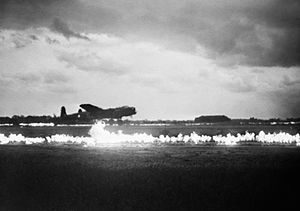
An aircraft landing at a FIDO airport. From Wikipedia.

An aircraft landing at a FIDO airport. From Wikipedia.

The contrast is that Cooper lets a reader who has never experienced FIDO a much clearer idea of what  it is, how it works, and what it’s like top fly into that situation, whereas Bennett is looking at it strictly from a functional point of view, which is fair seeing as he was one who had a say in its use and had to look at it more from a functionality point of view.

After the war, Cooper jumped around Canada as a pilot before settling in Gander working as a commercial pilot and as a bush pilot. Like his military career, his civilian career is equally exciting, and his memoir is full of terrifying, funny, and exciting stories. I plan to highlight a couple of those stories, but keep in mind each are told quickly in the book before he moves on to another.

Buchans Mining Co. crash of 1951

September 19, 1951, a Buchans Mining Co. Norseman crashed near South Pond, 25 miles north west of Buchans. Pilot Tom Mattinen, Dr. J. H. MacLean, chief geologist of the Buchans Mining Company, Ralph Barnes, George Pike, Patrick O’Keefe, all three geologists, and Roy Moran of Oakville and Douglas Derry of Toronto, engineers with Spartan Air Services, were all killed in the crash. Moran and Derry were visiting the pilot, and were going to be transported to Deer Lake where they were to work on Spartan helicopters who were having engine troubles (Dean 2000). On September 30, Captain Jerry McInnis and Cooper took DC-3 BXZ to pick up passengers in Buchans who held a funeral service while they flew over the wreck and dropped flowers from the aircraft. Such a service was not unusual for more isolated crashes, and a similar one happened over the 1946 American Overseas Airlines crash near Stephenville, NL.

Seal Spotting

Cooper was part of a long history of aviation seal spotting in Newfoundland and Labrador. In 1956, he went on his first seal spotting flight around the Strait of Bell Isle, and continued to work as a seal spotter for the next 15 years. Seal spotting started in Newfoundland with Sidney Cotton in the 1920, the sealing companies seeing the importance of aerial seal spotting and surveying for to guide seal hunters, making trips more productive and safer (Stone 2015). According to Cooper (1999) “unless you have seen a large seal herd, it is hard to believe that such a number of animals could concentrate in one area” (81) and “I did seal-spotting for over fifteen years, and to me, it seemed the herds were as large in 1972 as they were in 1956, the year I started” (82).
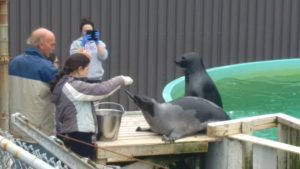
Seals at the Ocean Sciences Centre. Photo by author 2014.

Seals at the Ocean Sciences Centre. Photo by author 2014.

Stranded in the Snow

Cooper tells an exciting tale about getting caught in poor weather and having to make an emergency landing in what turned out to be a thick layer of fluffy snow (that’s not an oxymoron in Newfoundland) and ended up stuck in the bush for a few days in northern Newfoundland. I cannot do his story justice, but even knowing he got out, it was a great read. Something of interest that he does bring up during his story is that it happened mid-March and he was concerned about “Sheila’s Brush“, a storm that tends to happen around St. Patrick’s Day every year in Newfoundland. Cooper states:

I remembered that I had lost some very good friends on March 17, 1944. We lost two aircraft and crews on 125 Squadron in the RAF. Then on March 17, 1965, I lost two friends when EPA Dart Herald CF-NAF crashed in Nova Scotia, killing Captain Ray Murnaghan and First Officer Ross Clements (152).
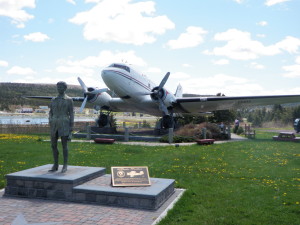
Spirit of Harbour Grace. Photo by author 2012.

Spirit of Harbour Grace. Photo by author 2012.

Commemoration

Cooper seemed to have had a hand in quite a bit of the aviation commemoration around the island. He was involved in the annual reunions of 125 (Nfld) Squadron, which expanded to 125 (Nfld) Squadron and Allied Air Forces Association, and was involved in the erection of the above mentioned Newfoundland Airman’s Memorial. He was one of the founding members of the North Atlantic Aviation Museum (NAAM) in Gander, and flew many of the aircraft that are now situated as memorials around Newfoundland. Some of those aircraft including his last flight in a DC-3 being CF-QBI which became the Spirit of Harbour Grace. He also flew Beechcraft B-18 CF-VPK from Toronto to Gander for it’s final home as a display outside of NAAM and flew DC-3 CF-GHX, which is now part of the Gander aviation museum. This and his work on Gander town council is most likely Mr. Cooper has a street named after him in Gander (Cooper Blvd.; see more at the Gander Airport Historical Society).
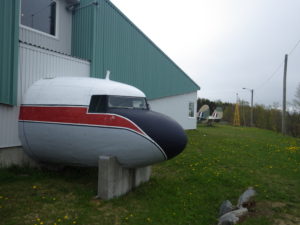
DC-3 as part of the North Atlantic Aviation Museum. Photo by author 2014.

DC-3 as part of the North Atlantic Aviation Museum. Photo by author 2014.

Royal Cooper took his flight logs and used them to write a fantastic memoir that I would encourage anyone with an interest in aviation or in Gander history to read. It is interesting, and tells the story of someone who loved his work, and who helped shape Gander. From building the first house on Hamilton Street when Gander moved from next to the airbase, to serving on council, and as mayor, to helping form the museum, Cooper shows a passion for aviation and the aviation town that is Gander.
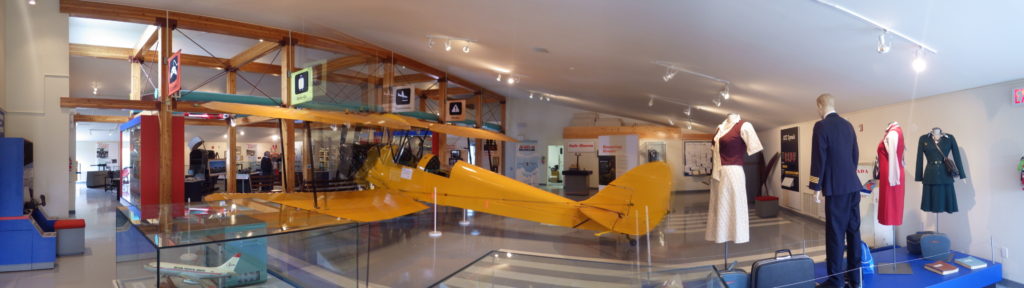
Inside the North Atlantic Aviation Museum. Photo by author 2014.

Inside the North Atlantic Aviation Museum. Photo by author 2014.


Sources

Bennett, D.C.T.
1958    Pathfinder. Guernsey Press, Guernsey.

Cooper, R.
1999   Tales from a Pilot’s Logbook: A Love Affair with Airplanes. Flanker Press Ltd.: St. John’s

Dean, P.
2010   Crash Victim’s Daughter Seeks Closure, The Telegram. September 21, 2010.

Shapleigh, P. and R. Moss
2000   The Newfoundland’s Airmen Memorial“We Will Remember”: War Monuments in Canada World Wide Web Site. Accessed 14 April 2016.

Stone, Robert C.
2015         A Gentlemen’s Agreement: Newfoundland and the Struggle for Transatlantic Air Supremacy. Boulder Publications: Portugal Cove-St. Philip’s.
 

RCAF Lodestar 557 (DfAp-15)

By Lisa M. Daly

Adapted from Daly 2015, post first published on the Gander Airport Historical Society page.

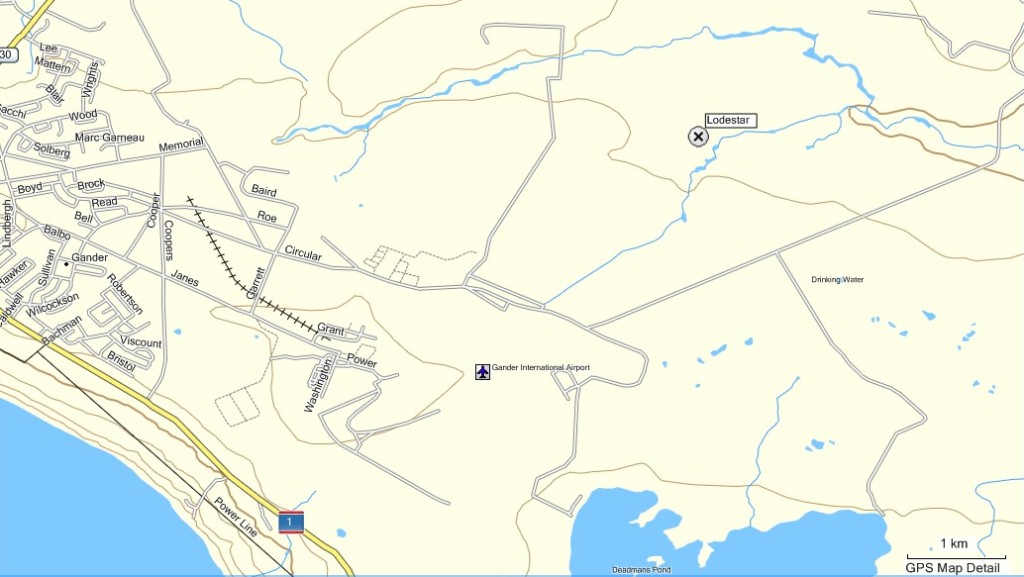
Map 1: Location of RCAF Lodestar 557 (DfAp-15) in relation to the Gander International Airport and side roads. From MapSource

Map 1: Location of RCAF Lodestar 557 (DfAp-15) in relation to the Gander International Airport and side roads. From MapSource


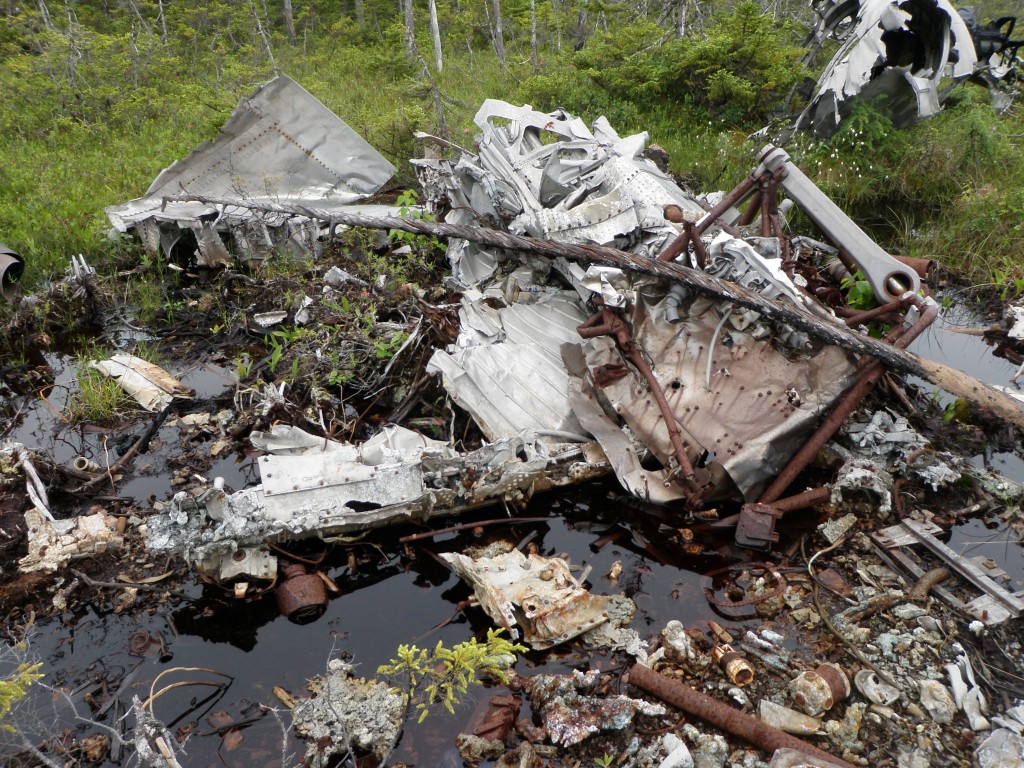
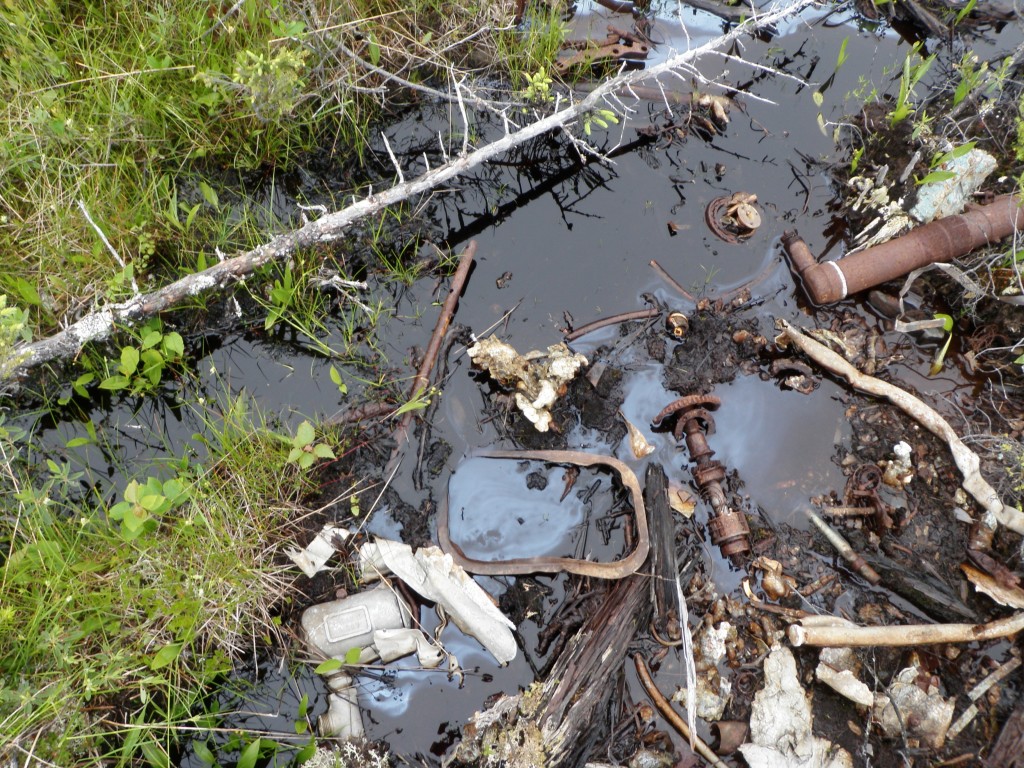
Royal Canadian Air Force Lodestar 557 (Borden DfAp-15) is currently located on the edge of a tree-lined bog with all of the wreckage being located in the bog. It sits between Radio Range Road and Boot Pond Road (map 1), but is a long and sometimes difficult hike through trees and bog. In fact, researchers had difficulty finding the sites, even with the information provided by historians, locals, and aviation engineers. The site is relatively intact, but is heavily contaminated. The point of impact where the aircraft burned is heavily contaminated with fuel, and much of the water around the wreckage has the rainbow colour that shows contamination (figure 1). Any archaeological work done on site was done with protective material, including heavy duty gloves, to ensure that contaminated water did not touch skin. The site should be approached with caution and care taken to avoid any fuel contamination.

Figure 1: Contamination of the site. Photo by author, 2011.

Figure 1: Contamination of the site. Photo by author, 2011.

Lodestar 557 departed Moncton. New Brunswick, at 2345 GMT on 7 May 1943 on a cargo transport flight to Gander. At 0313 GMT the following day, the aircraft contacted the Aerodrome Control Officer at Gander Station to request landing clearance. The aircraft was given landing clearance by P/O Thomas Howard Murray, aerodrome control officer, and was told to check their wheels down. The messages were acknowledged by 557. At this time the ceiling was practically unlimited. The aircraft was heard to pass over Gander airfield shortly thereafter, but the ceiling had unexpectedly fallen to 700 feet. This lowering of the ceiling possibly meant that ice may have formed on the aerials. It is unlikely that icing would have occurred on the wings or engines. This fly over was apparently done on instruments. The Lodestar contacted the Control Officer to indicate they had missed the field and were to try again. The aircraft then acknowledged being given the ceiling height and barometric pressure by the station.

Name

Rank Unit Duty Injuries
Svendsen, H. WO2 #164 Sqn. Pilot Fatal
Allen, C.H. WO2 #164 Sqn. 2nd Pilot Fatal
Sewell, A.G. LAC #164 Sqn. W/Opr. Fatal

Table 1: Crew of RCAF Lodestar 557. From Mulvihill 1943.

At this point, the landing of the aircraft on the control tower side was taken over by the station manager of Trans Canada Airlines (TCA), Mr. Harry Beardsell. The aircraft was carrying cargo and under the operational control of TCA and therefore should be under TVA radio coverage. Instructions were passed to the aircraft by TCA as to the proper landing procedures for Gander, and these were acknowledged. The aircraft broke through the now 600 ft. ceiling, and was advised to circle and approach runway 27 (note, runway 27 is no longer in use at YQX; ourairports.com). At this point, TCA spoke directly to the pilot. According to Beardsell, he advised Svendsen to make one more attempt before proceeding to Sydney where the ceiling was at 1000 ft. and visibility was 3 miles. P/O Murray, who was listening to the communications between the control tower and Lodestar 557 denied that the aircraft was advised of a secondary landing location. According to the radio log, it was actually Lodestar 557 who suggested that it would try for one more landing and if not successful would return to Sydney and TCA seconded the decision. The aircraft approached, but seemed to be lined up with the wrong runway and was advised to circle again and attempt runway 27. P/O Murray believed that the boundary lights were confusing 557, causing it to line up with the wrong runway, so he switched off the lights and informed the aircraft through Beardsell. One the second attempt, the aircraft did not turn enough and was again told that it would probably not make it to the runway and to attempt again. The aircraft was told to make a right turn over the field near the airport, but it could be seen that the aircraft would not make the turn successfully. The pilot was advised to pull up two or three times by TCA, but at this point 557 was in a steep bank and went into a stall, losing altitude until it crashed. One witness saw the aircraft moments before the crash and stated it was flying very low at 200 ft. with engines functioning properly. The crash was indicated by a flash followed by a second, brighter flash, indicating it had crashed and was burning. Fire trucks and ambulances were dispatched to the scene. It crashed at 0340 GMT on 8 May 1943 approximately two miles east of the RCAF Station in Gander. All crew were killed and found in their proper seats in the aircraft (Table 1; Mulvihill 1943). The crew were buried at the Commonwealth War Graves in Gander.

According to the accident report:

AIRCRAFT:               Scattered over a small area but distributed over approximately 190 yard line. The starboard wing tip made first contact with a tree and then the port with the resultant that the starboard wing came off first, followed by the port. The fuselage continued on and finally both wheels struck the ground, at this point the aircraft must have bounced into the woods where it caught fire and was almost completely burned out except for portion just forward of the rear door to and including the empennage.

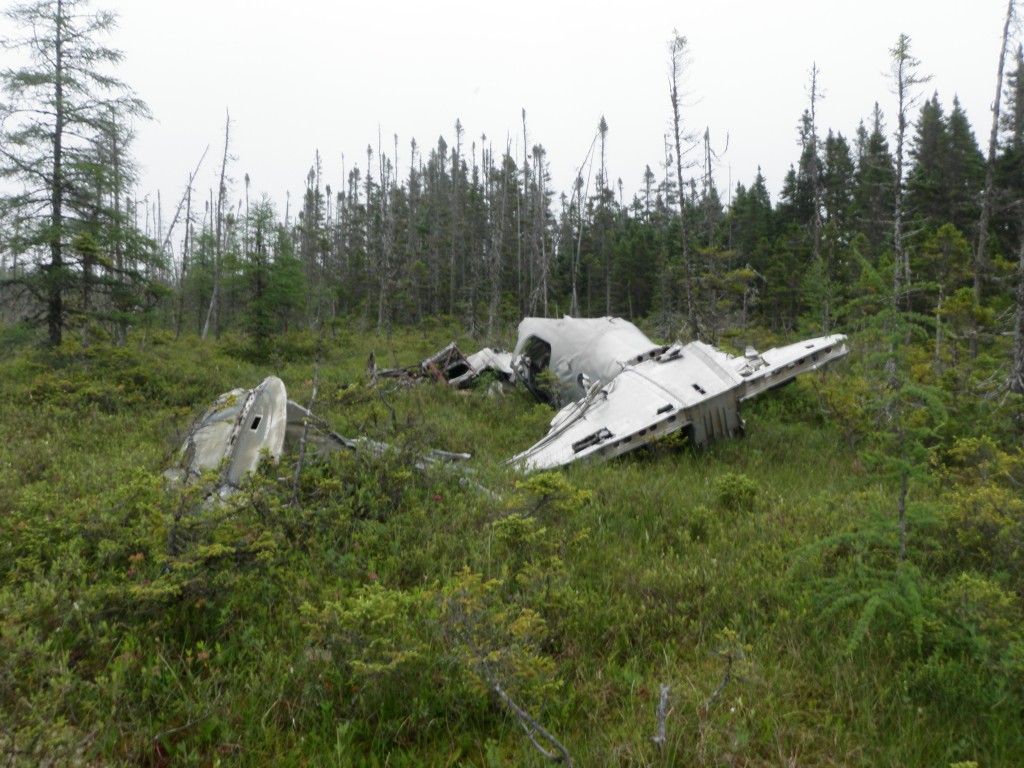
EMPENNAGE:          The empennage [tail assembly] was twisted completely around and was facing in the opposite to normal direction (figure 2).

Figure 2: The tail of the aircraft, slightly twisted and fragmented. Photo by author, 2011.

Figure 2: The tail of the aircraft, slightly twisted and fragmented. Photo by author, 2011.

WINGS:                      Starboard damaged but not seriously while the port was fairly well intact, but both were torn from centre section outboard of root fittings.

FLAPS:                       It was observed on examining the crash that the section of flaps remaining on the centre section was in the up position. It is improbable the flaps would have been retracted as a result of the crash.

INSTRUMENTS:       There were no instruments or controls present to indicate the attitude [sic] of the aircraft or the performance of the engines.

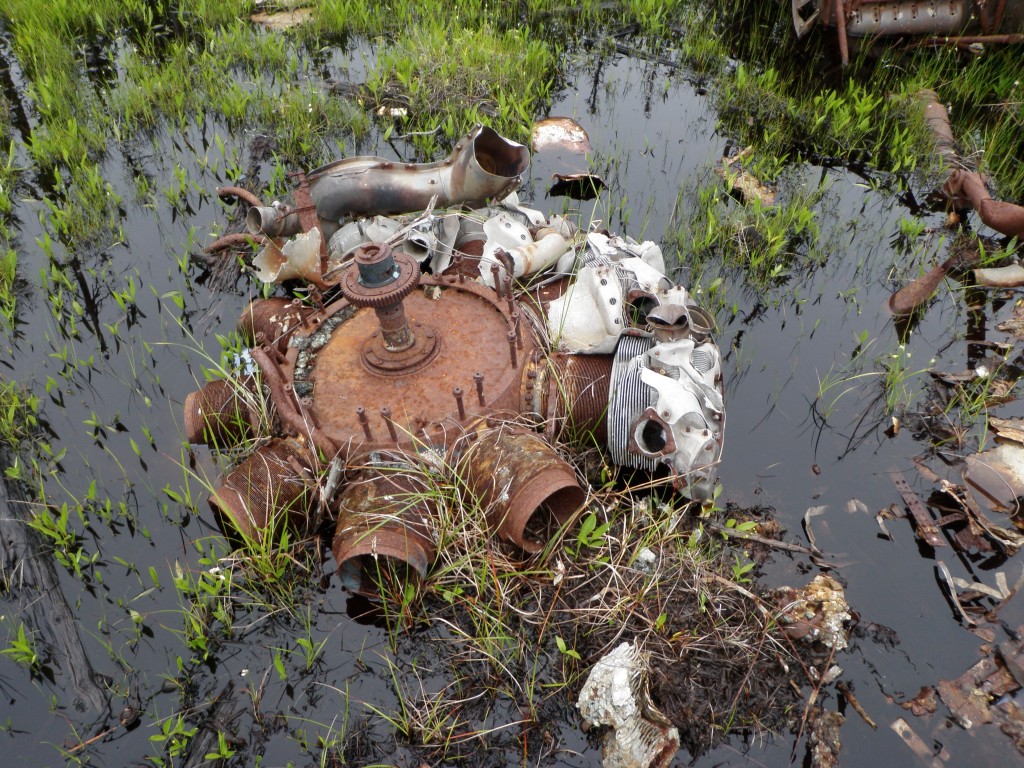
ENGINES:                  Port engine was seriously damaged while the starboard was completely burned out. The salvage from the two engines would be almost negligible (figure 3).

Figure 3: Engine in the main area of the crash. Photo by author, 2011.

Figure 3: Engine in the main area of the crash. Photo by author, 2011.

UNDERCARRIAGE: The undercarriage was severely twisted but it appears certain that it was locked “down” at the moment of impact, since one of the [botusting] cylinders was found in the retractor or “undercarriage locked down” position and it is considered impossible for the cylinder to be forced into this position by a crash. The other cylinder was partially extended but this could have been caused by the crash. In addition one of the drag struts was observed to be buckled as indicating it had experienced a severe compression load which it could not experience if the undercarriage had been retracted.

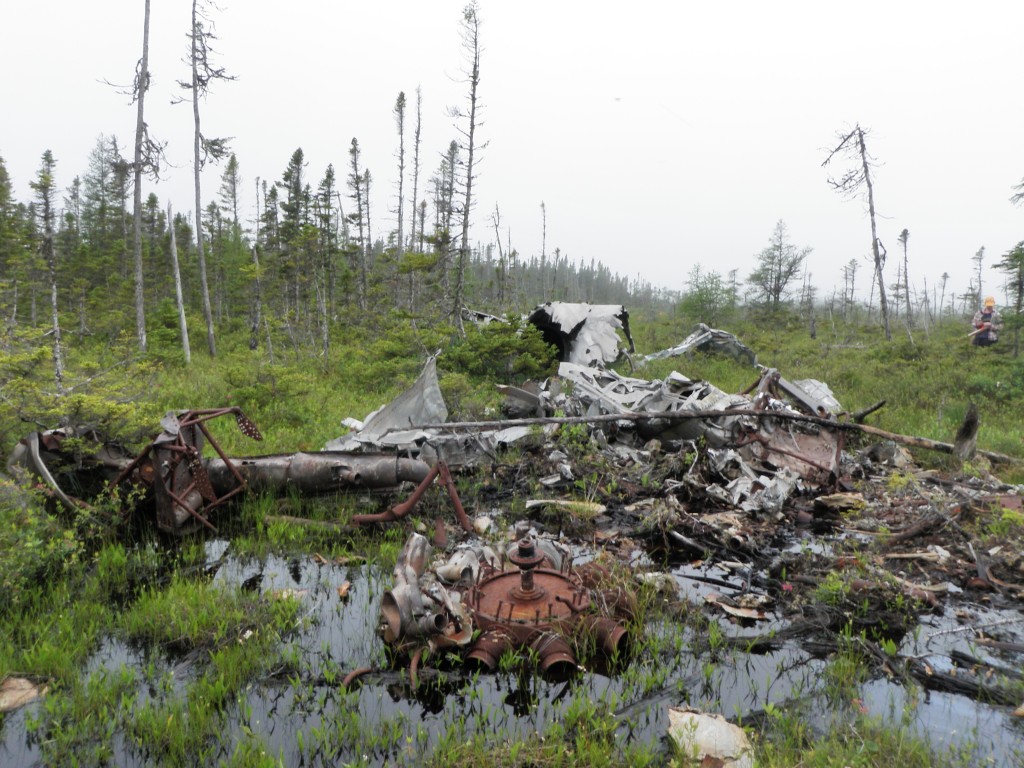
GENERAL:    Other than the above, all other parts of the aircraft were so badly damaged or burnt that they were of no value in disclosing further information (figure 4; Mulvihill 1943b).

Figure 4: The crash site. Photo by author, 2011.

Figure 4: The crash site. Photo by author, 2011.

The aircraft had been certified as airworthy and in serviceable condition; the pilot, WO2 Svendsen, was fully qualified to fly a Lodestar in all conditions, and had twice flown the same route to Gander on transportation flights. The cause of the crash was determined to be “pilot error, while attempting to get into position to make approach under low ceiling” (Mulvihill 1943). The aircraft slipped or stalled after changing from a left turn to a right turn in an attempt to realign with the runway. Because it was already in low altitude, the slip or stall caused it to strike the trees while trying to recover from the turn. The report recommends safety changes to the airbase. As Lodestar 557 had to make a final attempt because it had aligned with the wrong runway, the report determined that the runway lighting system of the RCAF station in Gander was confusing and should be studied and improved (Mulvihill 1943).

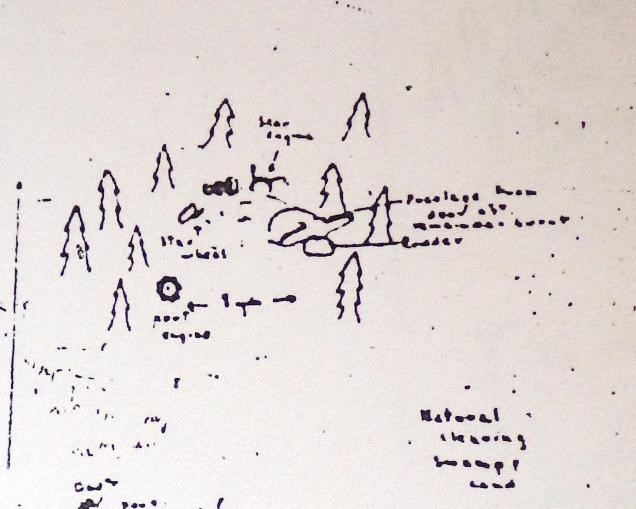
Figure 5: Sketch of the RCAF Lodestar crash site. From Mulvihill 1943.

Figure 5: Sketch of the RCAF Lodestar crash site. From Mulvihill 1943.

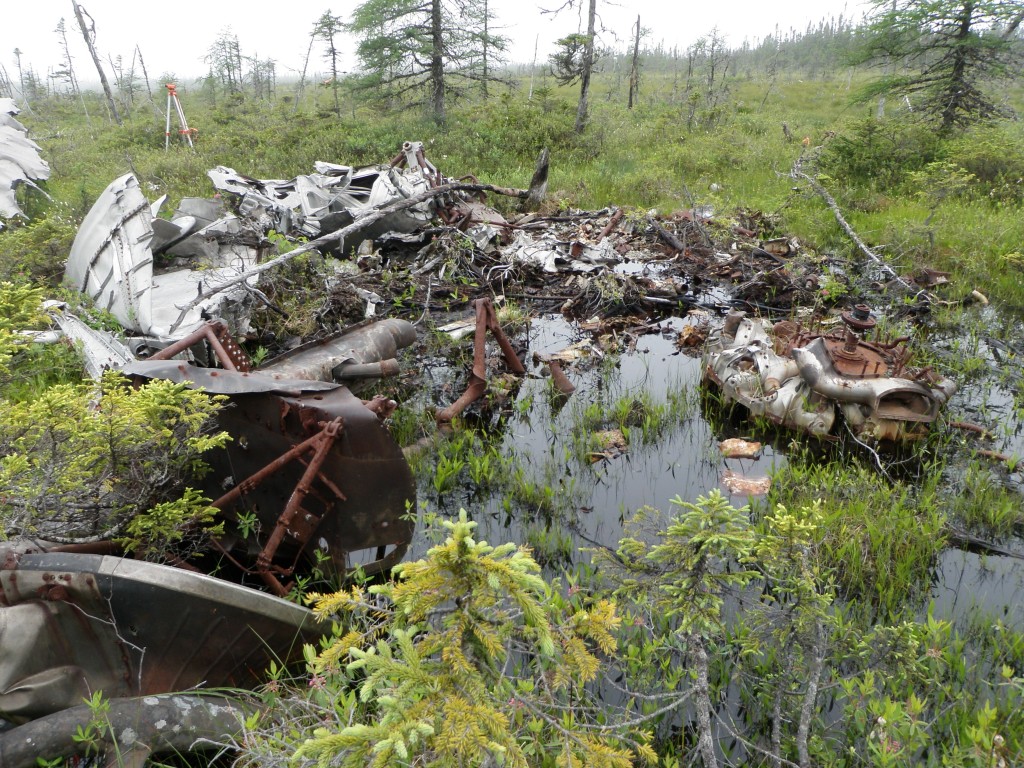
Based on a comparison of the archaeological investigation and the incident report, the site is mainly intact. Even a comparison of the sketch in the report, the site map, and recent pictures of the site show an almost identical layout of the crash site. It is known that this site has been visited (based on conversations with people from Gander), but very little seems to have been removed. Interestingly, most people who visited the site in the past, or who know of it, have the impression that the site has largely been recovered or looted by salvagers in the recent past. Contrary to this, the site shows very little disturbance, to the extent that the tail rudder appears to be in the same location as indicated by the 1943 map. In agreement with the crash report, the cockpit, including all instruments, was destroyed. What is present on the site is an area of slag with pieces of instruments and aircraft scattered throughout. This area was explored by archaeologists, but instead of trying to measure in every piece and burnt fragment, some of which could not be identified because they were too deep under contaminated water to be moved, it was decided that the points of measurement would be taken around the area and large, identifiable pieces, such as engines, would be measured separately. In fact, it was a similar method used to create the 1943 map (figure 5; figures 6 & 7).

Lodestar fig 6

Figure 6 7: The burnt area of the crash site. Photos by author, 2011.

Figure 6 7: The burnt area of the crash site. Photos by author, 2011.

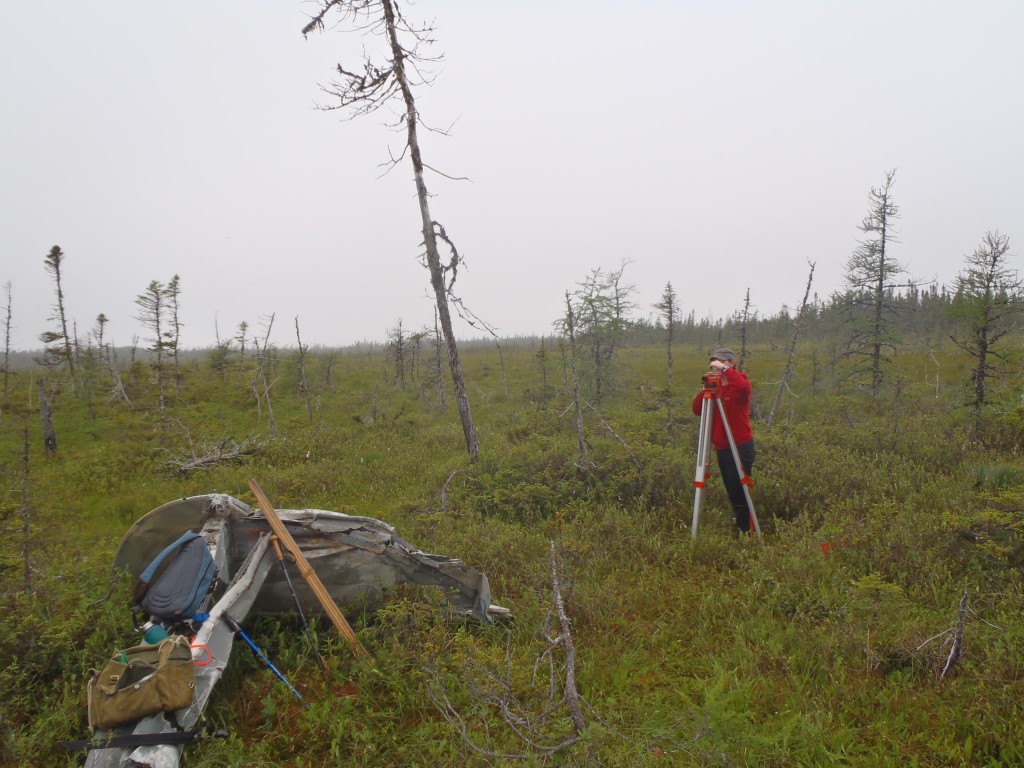
Due to the fact that the crash report describes the scene in such great detail, and the site is still very much intact, the archaeological analysis does not add much information about the crash. One exception is that pieces of the aircraft were found up to and over 30m west of the main impact point. These pieces were measure into the map first by using a 30m measuring tape until pieces were too far, then they were measured directly from the stadia rod. Most of the site was measured into the map using a measuring tape and surveyor’s level (figure 8). The pieces the furthest from the wreckage indicated that the burnt area was not the first area of contact during the crash, but that Lodestar 557 clipped the trees and began taking damage prior to the final impact. This is mentioned in the report, but the artifact distribution better indicates how the aircraft came in while attempting to turn.

Figure 8: Surveying the wreckage. Photo by Kathleen Elwood, 2011.

Figure 8: Surveying the wreckage. Photo by Kathleen Elwood, 2011.

While it was stated that the archaeological investigation did not add much to the information available in the incident report, this site is of archaeological importance due to the fact that it is very much intact. It is a relatively well-known crash site around Gander, but because it is a fair distance from any road or path, it is difficult to access and is therefore mostly untouched by site visitors. As well, the fact that the crash report and the archaeological investigation line up so neatly is a way for archaeologists to check their methods and make improvements for the investigation of other sites as necessary. Very little post-war damage has occurred at this site, and now that it is listed as an archaeological site and given its remote location, it will continue to remain intact.


Sources:

Daly, L.
2015      Aviation Archaeology of World War II Gander: An Examination of Military and Civilian Life at the Newfoundland Airport. Doctoral (PhD) thesis, Memorial University of Newfoundland.

Hillier, D. (historian)
2010      Personal Communication

Mahr, R. (aviation engineer)
2010      Personal Communication

Mulvihill, J.C.
1943      Lodestar Aircraft: R.C.A.F. No. 557: Accident to Above at Gander Nfld., on 7-5-43 WO. 2. H. Svendsen, WO. 2 A.C. Needham LAC A.G. Sevell All Killed. Royal Canadian Air Force, Gander.

Ourairports.com.
2006      YQX pilot info. http://ourairports.com/airports/CYQX/pilot-info.html#runways (Accessed 23 Feb 2016).