Conflict Archaeology

All posts tagged Conflict Archaeology

RCAF Lodestar 557 (DfAp-15)

By Lisa M. Daly

Adapted from Daly 2015, post first published on the Gander Airport Historical Society page.
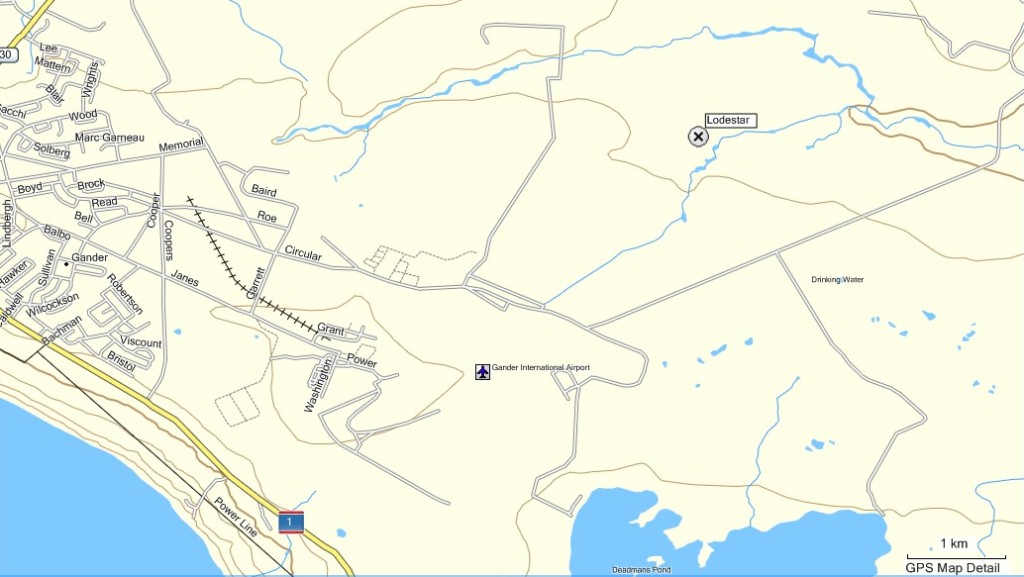
Map 1: Location of RCAF Lodestar 557 (DfAp-15) in relation to the Gander International Airport and side roads. From MapSource

Map 1: Location of RCAF Lodestar 557 (DfAp-15) in relation to the Gander International Airport and side roads. From MapSource


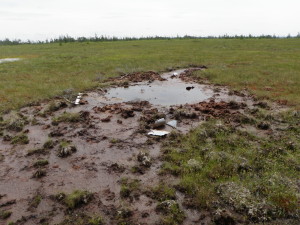
Royal Canadian Air Force Lodestar 557 (Borden DfAp-15) is currently located on the edge of a tree-lined bog with all of the wreckage being located in the bog. It sits between Radio Range Road and Boot Pond Road (map 1), but is a long and sometimes difficult hike through trees and bog. In fact, researchers had difficulty finding the sites, even with the information provided by historians, locals, and aviation engineers. The site is relatively intact, but is heavily contaminated. The point of impact where the aircraft burned is heavily contaminated with fuel, and much of the water around the wreckage has the rainbow colour that shows contamination (figure 1). Any archaeological work done on site was done with protective material, including heavy duty gloves, to ensure that contaminated water did not touch skin. The site should be approached with caution and care taken to avoid any fuel contamination.
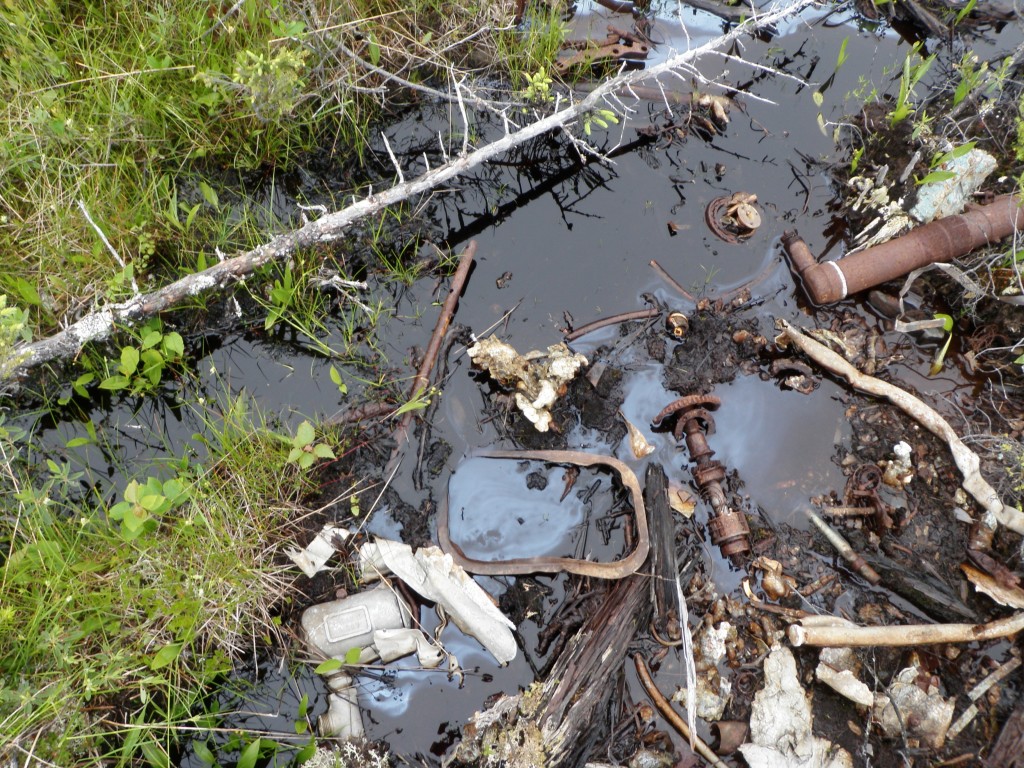
Figure 1: Contamination of the site. Photo by author, 2011.

Figure 1: Contamination of the site. Photo by author, 2011.

Lodestar 557 departed Moncton. New Brunswick, at 2345 GMT on 7 May 1943 on a cargo transport flight to Gander. At 0313 GMT the following day, the aircraft contacted the Aerodrome Control Officer at Gander Station to request landing clearance. The aircraft was given landing clearance by P/O Thomas Howard Murray, aerodrome control officer, and was told to check their wheels down. The messages were acknowledged by 557. At this time the ceiling was practically unlimited. The aircraft was heard to pass over Gander airfield shortly thereafter, but the ceiling had unexpectedly fallen to 700 feet. This lowering of the ceiling possibly meant that ice may have formed on the aerials. It is unlikely that icing would have occurred on the wings or engines. This fly over was apparently done on instruments. The Lodestar contacted the Control Officer to indicate they had missed the field and were to try again. The aircraft then acknowledged being given the ceiling height and barometric pressure by the station.

Name

Rank Unit Duty Injuries
Svendsen, H. WO2 #164 Sqn. Pilot Fatal
Allen, C.H. WO2 #164 Sqn. 2nd Pilot Fatal
Sewell, A.G. LAC #164 Sqn. W/Opr. Fatal

Table 1: Crew of RCAF Lodestar 557. From Mulvihill 1943.

At this point, the landing of the aircraft on the control tower side was taken over by the station manager of Trans Canada Airlines (TCA), Mr. Harry Beardsell. The aircraft was carrying cargo and under the operational control of TCA and therefore should be under TVA radio coverage. Instructions were passed to the aircraft by TCA as to the proper landing procedures for Gander, and these were acknowledged. The aircraft broke through the now 600 ft. ceiling, and was advised to circle and approach runway 27 (note, runway 27 is no longer in use at YQX; ourairports.com). At this point, TCA spoke directly to the pilot. According to Beardsell, he advised Svendsen to make one more attempt before proceeding to Sydney where the ceiling was at 1000 ft. and visibility was 3 miles. P/O Murray, who was listening to the communications between the control tower and Lodestar 557 denied that the aircraft was advised of a secondary landing location. According to the radio log, it was actually Lodestar 557 who suggested that it would try for one more landing and if not successful would return to Sydney and TCA seconded the decision. The aircraft approached, but seemed to be lined up with the wrong runway and was advised to circle again and attempt runway 27. P/O Murray believed that the boundary lights were confusing 557, causing it to line up with the wrong runway, so he switched off the lights and informed the aircraft through Beardsell. One the second attempt, the aircraft did not turn enough and was again told that it would probably not make it to the runway and to attempt again. The aircraft was told to make a right turn over the field near the airport, but it could be seen that the aircraft would not make the turn successfully. The pilot was advised to pull up two or three times by TCA, but at this point 557 was in a steep bank and went into a stall, losing altitude until it crashed. One witness saw the aircraft moments before the crash and stated it was flying very low at 200 ft. with engines functioning properly. The crash was indicated by a flash followed by a second, brighter flash, indicating it had crashed and was burning. Fire trucks and ambulances were dispatched to the scene. It crashed at 0340 GMT on 8 May 1943 approximately two miles east of the RCAF Station in Gander. All crew were killed and found in their proper seats in the aircraft (Table 1; Mulvihill 1943). The crew were buried at the Commonwealth War Graves in Gander.

According to the accident report:

AIRCRAFT:               Scattered over a small area but distributed over approximately 190 yard line. The starboard wing tip made first contact with a tree and then the port with the resultant that the starboard wing came off first, followed by the port. The fuselage continued on and finally both wheels struck the ground, at this point the aircraft must have bounced into the woods where it caught fire and was almost completely burned out except for portion just forward of the rear door to and including the empennage.

EMPENNAGE:          The empennage [tail assembly] was twisted completely around and was facing in the opposite to normal direction (figure 2).
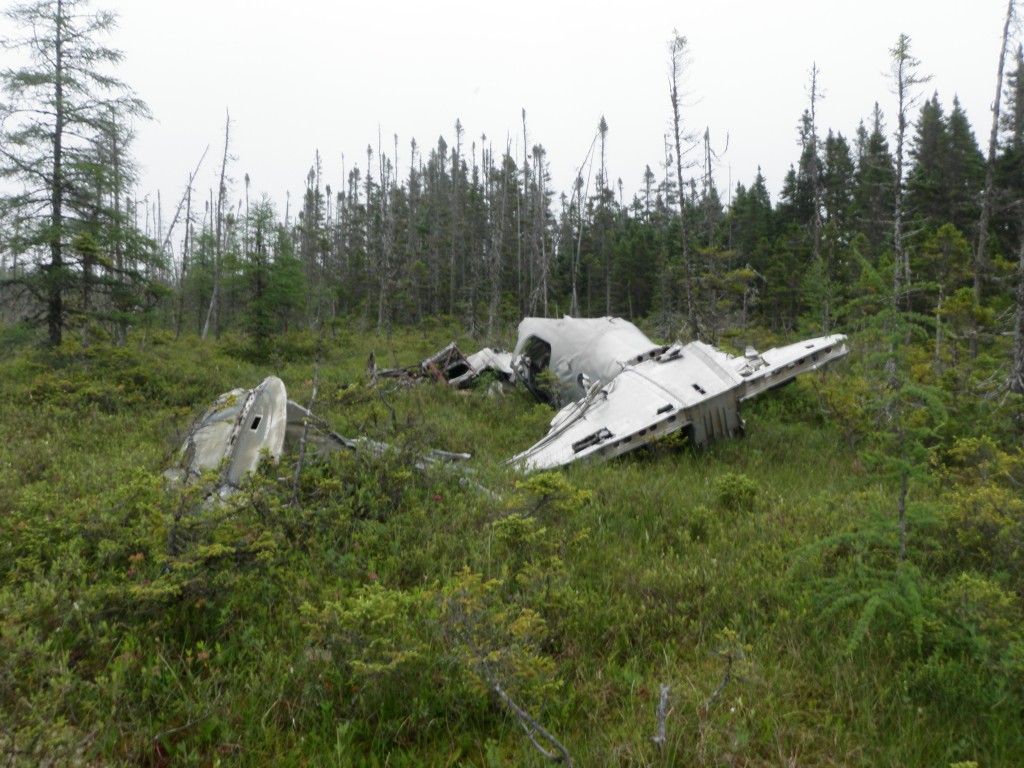
Figure 2: The tail of the aircraft, slightly twisted and fragmented. Photo by author, 2011.

Figure 2: The tail of the aircraft, slightly twisted and fragmented. Photo by author, 2011.

WINGS:                      Starboard damaged but not seriously while the port was fairly well intact, but both were torn from centre section outboard of root fittings.

FLAPS:                       It was observed on examining the crash that the section of flaps remaining on the centre section was in the up position. It is improbable the flaps would have been retracted as a result of the crash.

INSTRUMENTS:       There were no instruments or controls present to indicate the attitude [sic] of the aircraft or the performance of the engines.

ENGINES:                  Port engine was seriously damaged while the starboard was completely burned out. The salvage from the two engines would be almost negligible (figure 3).
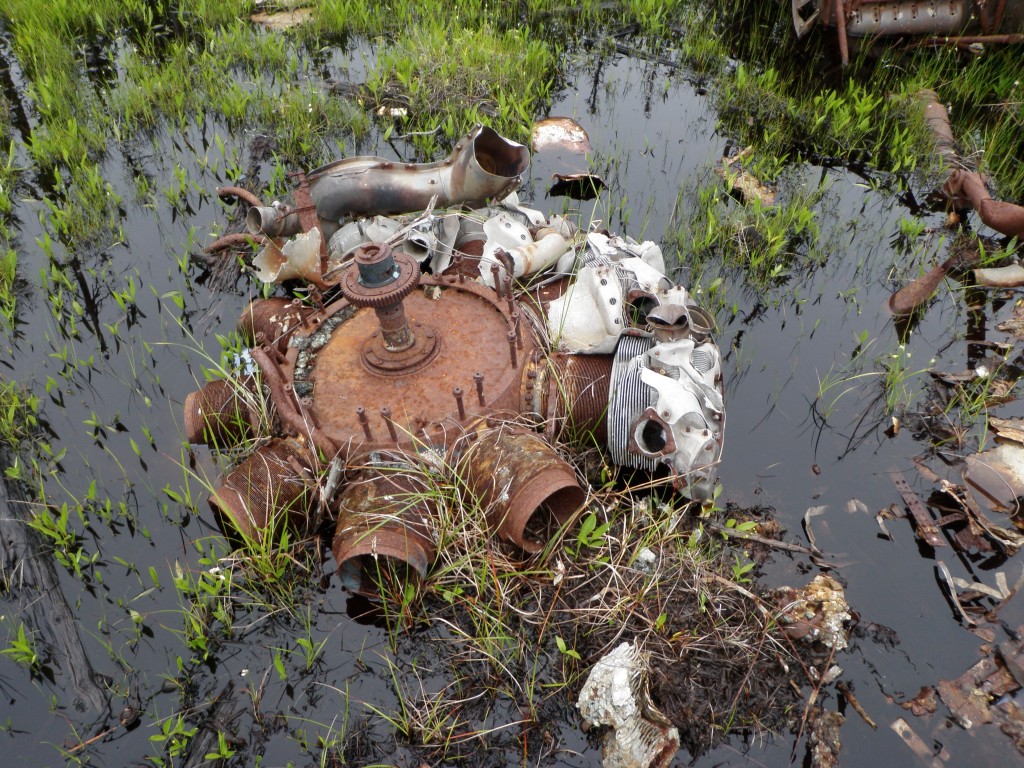
Figure 3: Engine in the main area of the crash. Photo by author, 2011.

Figure 3: Engine in the main area of the crash. Photo by author, 2011.

UNDERCARRIAGE: The undercarriage was severely twisted but it appears certain that it was locked “down” at the moment of impact, since one of the [botusting] cylinders was found in the retractor or “undercarriage locked down” position and it is considered impossible for the cylinder to be forced into this position by a crash. The other cylinder was partially extended but this could have been caused by the crash. In addition one of the drag struts was observed to be buckled as indicating it had experienced a severe compression load which it could not experience if the undercarriage had been retracted.

GENERAL:    Other than the above, all other parts of the aircraft were so badly damaged or burnt that they were of no value in disclosing further information (figure 4; Mulvihill 1943b).
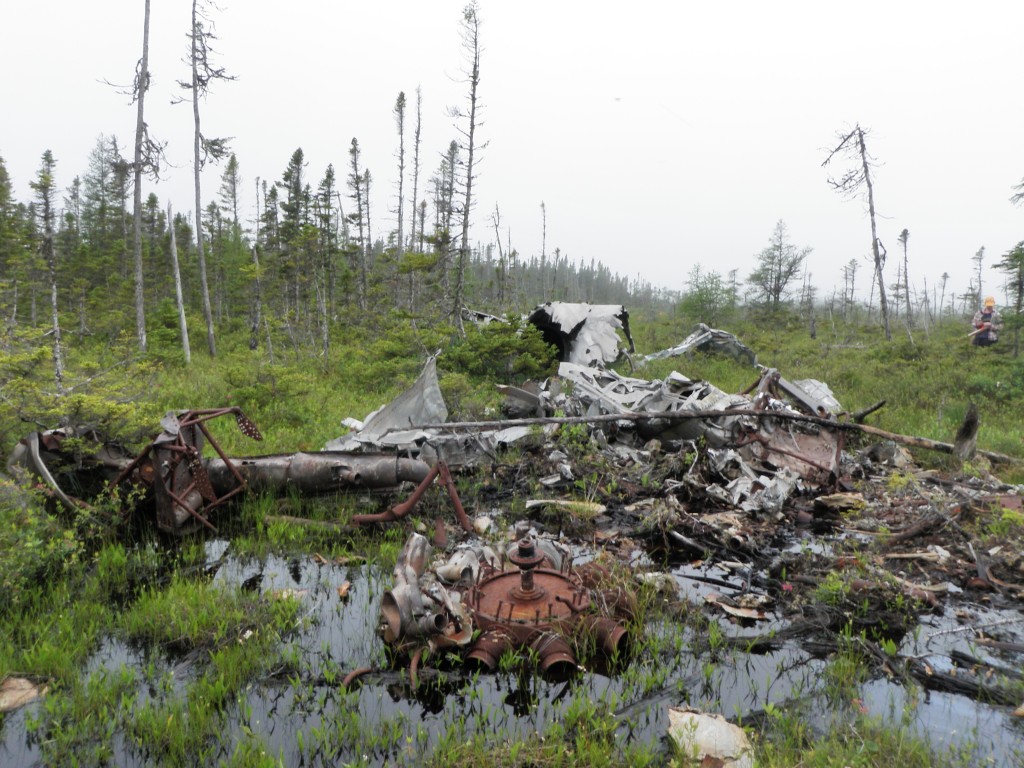
Figure 4: The crash site. Photo by author, 2011.

Figure 4: The crash site. Photo by author, 2011.

The aircraft had been certified as airworthy and in serviceable condition; the pilot, WO2 Svendsen, was fully qualified to fly a Lodestar in all conditions, and had twice flown the same route to Gander on transportation flights. The cause of the crash was determined to be “pilot error, while attempting to get into position to make approach under low ceiling” (Mulvihill 1943). The aircraft slipped or stalled after changing from a left turn to a right turn in an attempt to realign with the runway. Because it was already in low altitude, the slip or stall caused it to strike the trees while trying to recover from the turn. The report recommends safety changes to the airbase. As Lodestar 557 had to make a final attempt because it had aligned with the wrong runway, the report determined that the runway lighting system of the RCAF station in Gander was confusing and should be studied and improved (Mulvihill 1943).
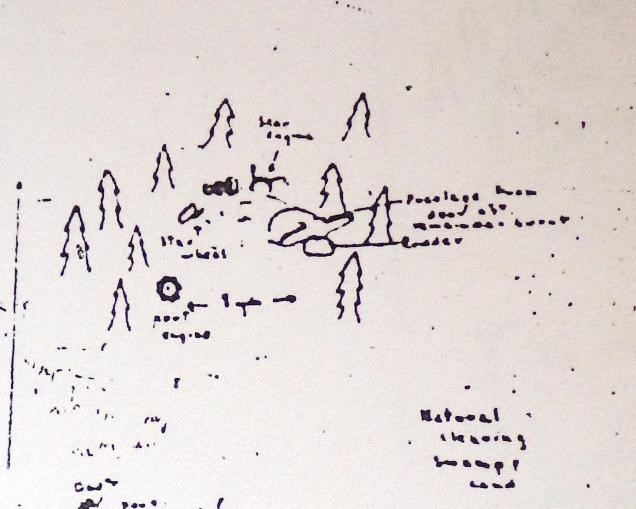
Figure 5: Sketch of the RCAF Lodestar crash site. From Mulvihill 1943.

Figure 5: Sketch of the RCAF Lodestar crash site. From Mulvihill 1943.

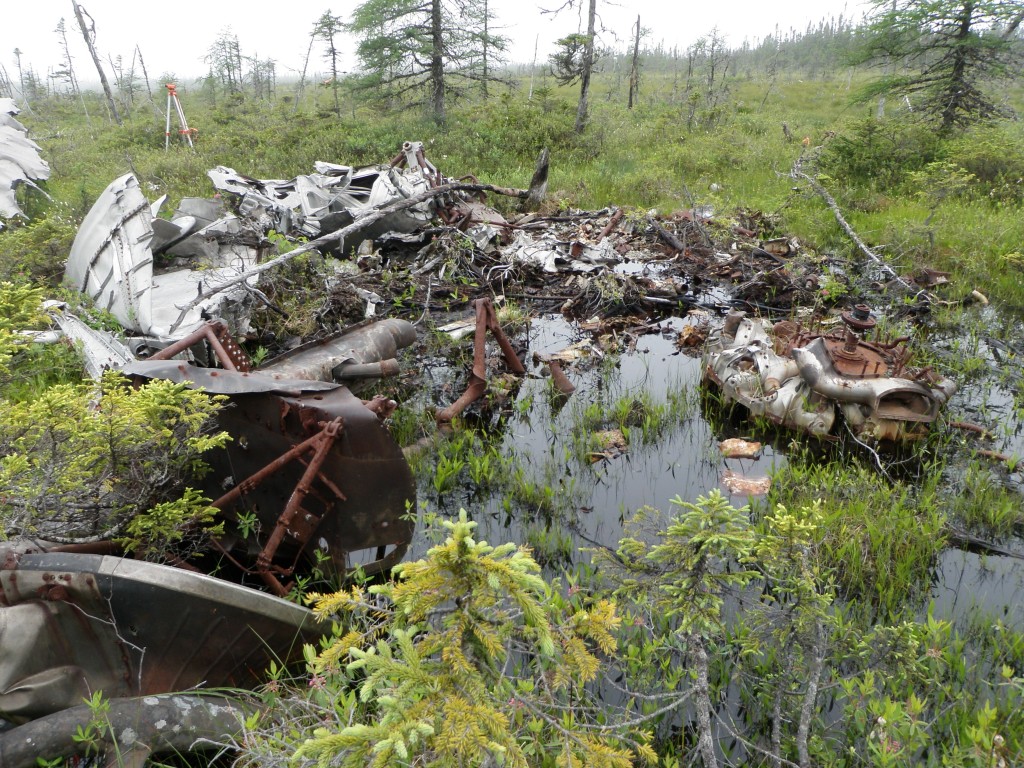
Based on a comparison of the archaeological investigation and the incident report, the site is mainly intact. Even a comparison of the sketch in the report, the site map, and recent pictures of the site show an almost identical layout of the crash site. It is known that this site has been visited (based on conversations with people from Gander), but very little seems to have been removed. Interestingly, most people who visited the site in the past, or who know of it, have the impression that the site has largely been recovered or looted by salvagers in the recent past. Contrary to this, the site shows very little disturbance, to the extent that the tail rudder appears to be in the same location as indicated by the 1943 map. In agreement with the crash report, the cockpit, including all instruments, was destroyed. What is present on the site is an area of slag with pieces of instruments and aircraft scattered throughout. This area was explored by archaeologists, but instead of trying to measure in every piece and burnt fragment, some of which could not be identified because they were too deep under contaminated water to be moved, it was decided that the points of measurement would be taken around the area and large, identifiable pieces, such as engines, would be measured separately. In fact, it was a similar method used to create the 1943 map (figure 5; figures 6 & 7).
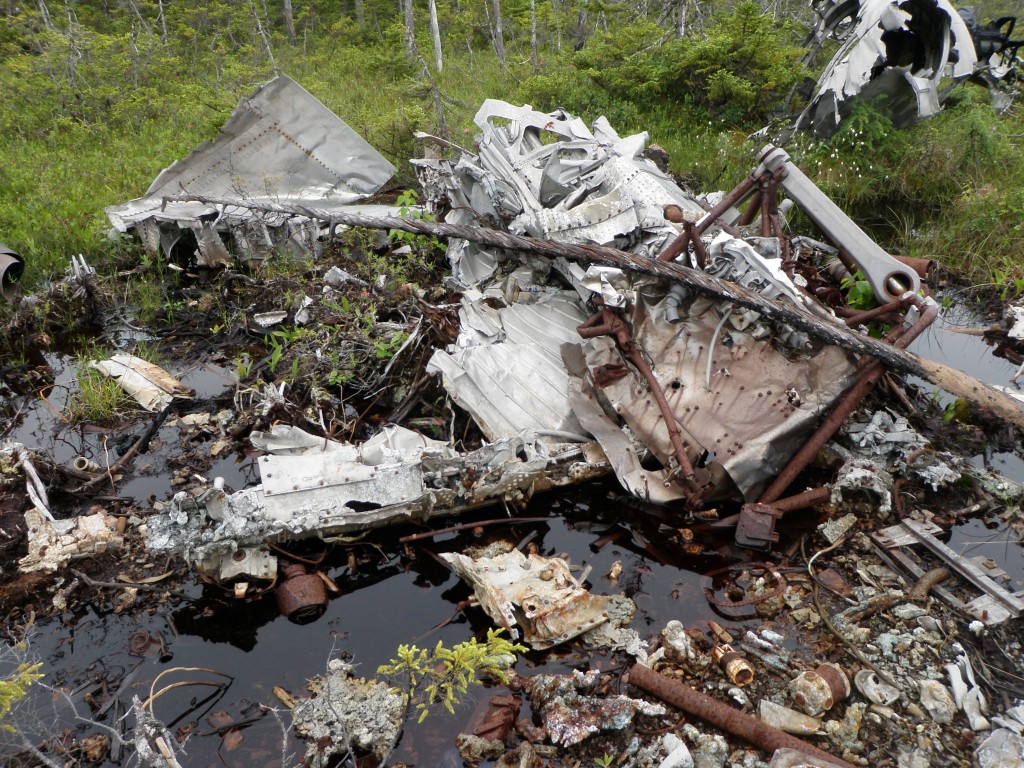
Lodestar fig 6

Figure 6 7: The burnt area of the crash site. Photos by author, 2011.

Figure 6 7: The burnt area of the crash site. Photos by author, 2011.

Due to the fact that the crash report describes the scene in such great detail, and the site is still very much intact, the archaeological analysis does not add much information about the crash. One exception is that pieces of the aircraft were found up to and over 30m west of the main impact point. These pieces were measure into the map first by using a 30m measuring tape until pieces were too far, then they were measured directly from the stadia rod. Most of the site was measured into the map using a measuring tape and surveyor’s level (figure 8). The pieces the furthest from the wreckage indicated that the burnt area was not the first area of contact during the crash, but that Lodestar 557 clipped the trees and began taking damage prior to the final impact. This is mentioned in the report, but the artifact distribution better indicates how the aircraft came in while attempting to turn.
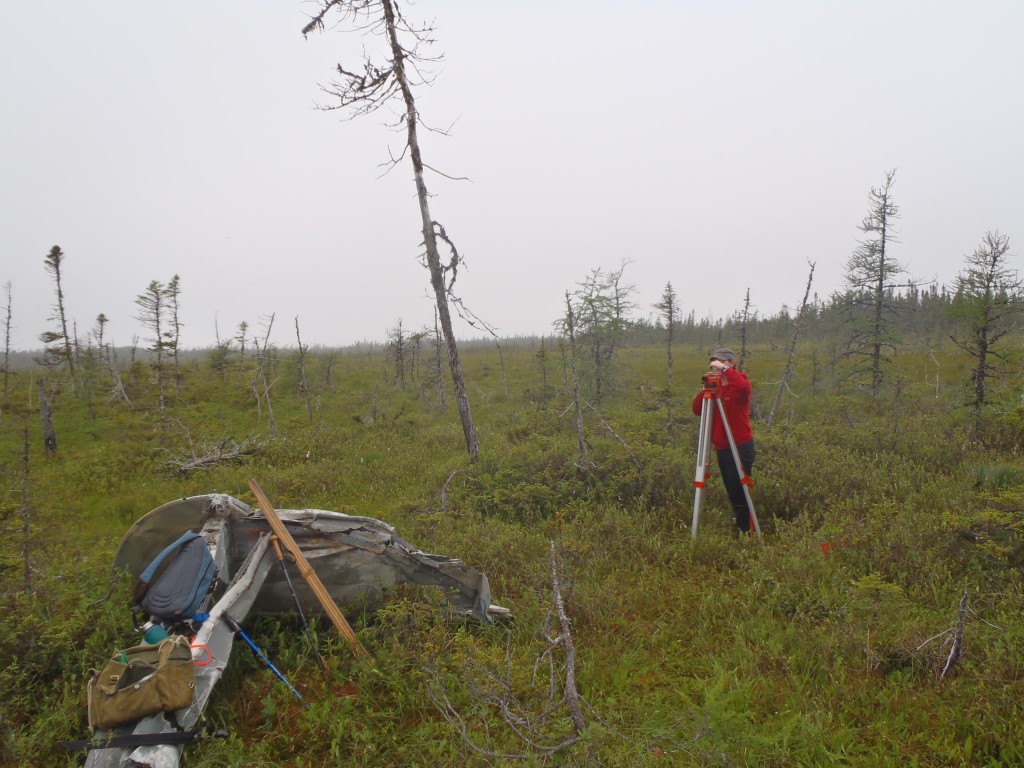
Figure 8: Surveying the wreckage. Photo by Kathleen Elwood, 2011.

Figure 8: Surveying the wreckage. Photo by Kathleen Elwood, 2011.

While it was stated that the archaeological investigation did not add much to the information available in the incident report, this site is of archaeological importance due to the fact that it is very much intact. It is a relatively well-known crash site around Gander, but because it is a fair distance from any road or path, it is difficult to access and is therefore mostly untouched by site visitors. As well, the fact that the crash report and the archaeological investigation line up so neatly is a way for archaeologists to check their methods and make improvements for the investigation of other sites as necessary. Very little post-war damage has occurred at this site, and now that it is listed as an archaeological site and given its remote location, it will continue to remain intact.


Sources:

Daly, L.
2015      Aviation Archaeology of World War II Gander: An Examination of Military and Civilian Life at the Newfoundland Airport. Doctoral (PhD) thesis, Memorial University of Newfoundland.

Hillier, D. (historian)
2010      Personal Communication

Mahr, R. (aviation engineer)
2010      Personal Communication

Mulvihill, J.C.
1943      Lodestar Aircraft: R.C.A.F. No. 557: Accident to Above at Gander Nfld., on 7-5-43 WO. 2. H. Svendsen, WO. 2 A.C. Needham LAC A.G. Sevell All Killed. Royal Canadian Air Force, Gander.

Ourairports.com.
2006      YQX pilot info. http://ourairports.com/airports/CYQX/pilot-info.html#runways (Accessed 23 Feb 2016).
My originally scheduled post was supposed to be a review of A Gentlemen’s Agreement: Newfoundland and the Struggle for Transatlantic Air Supremacy by Robert C. Stone, but I still have half of the book to read. I figured it would be unfair to quickly read the remainder of the book just for a blog review, so instead I am posting the next scheduled post instead. This was first adapted from my own thesis, then a version of it posted on the Gander Airport Historical Society page under their Warbird Down section. So, while you may not know my planned schedule, I really am trying my best to stick to it this year to bring you new content every second week.

On to explore RCAF Digby 742, crashed at Gander. For video of this site, please see my Land and Sea episode “Fallen War Birds“.

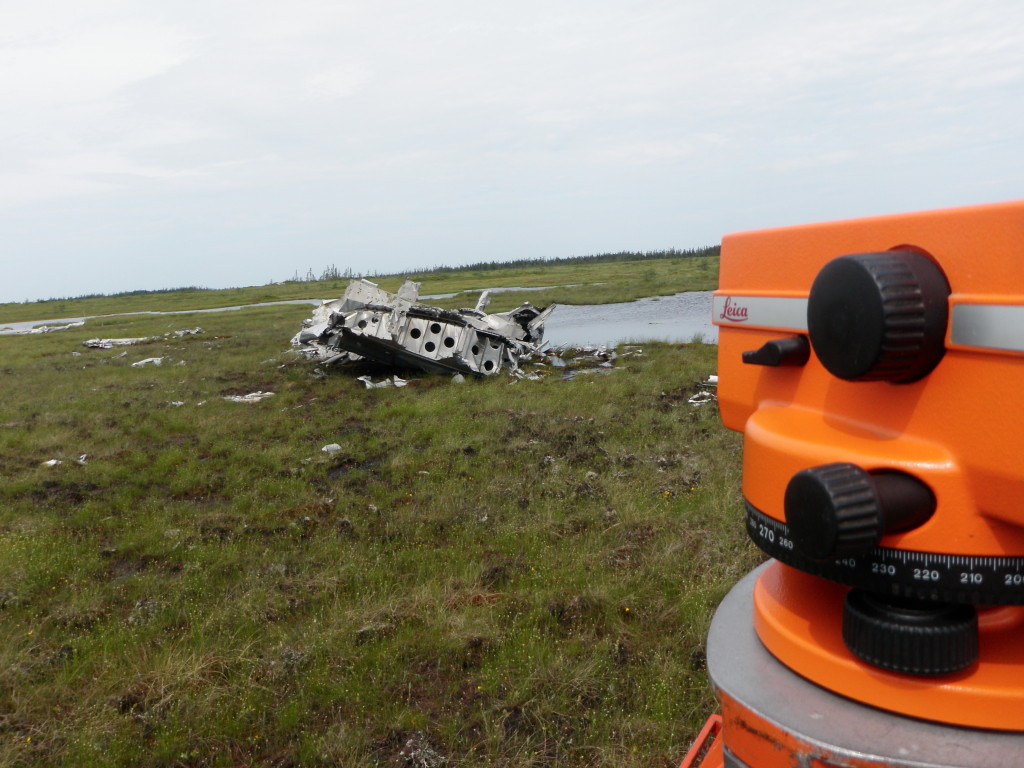
Measuring the debris field. Photo by author, 2010.

Measuring the debris field. Photo by author, 2010.

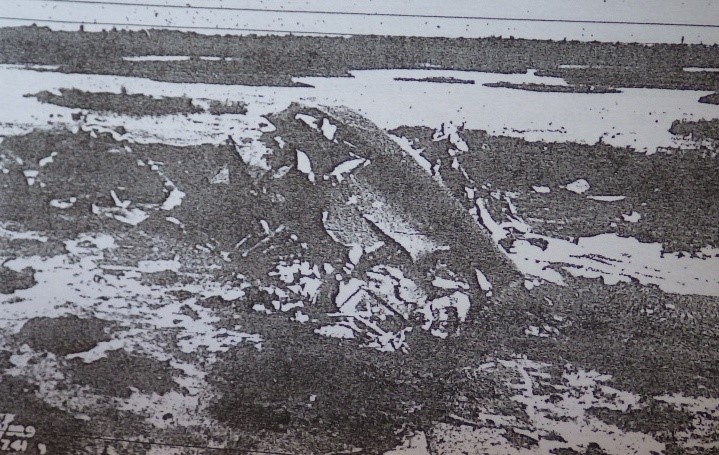
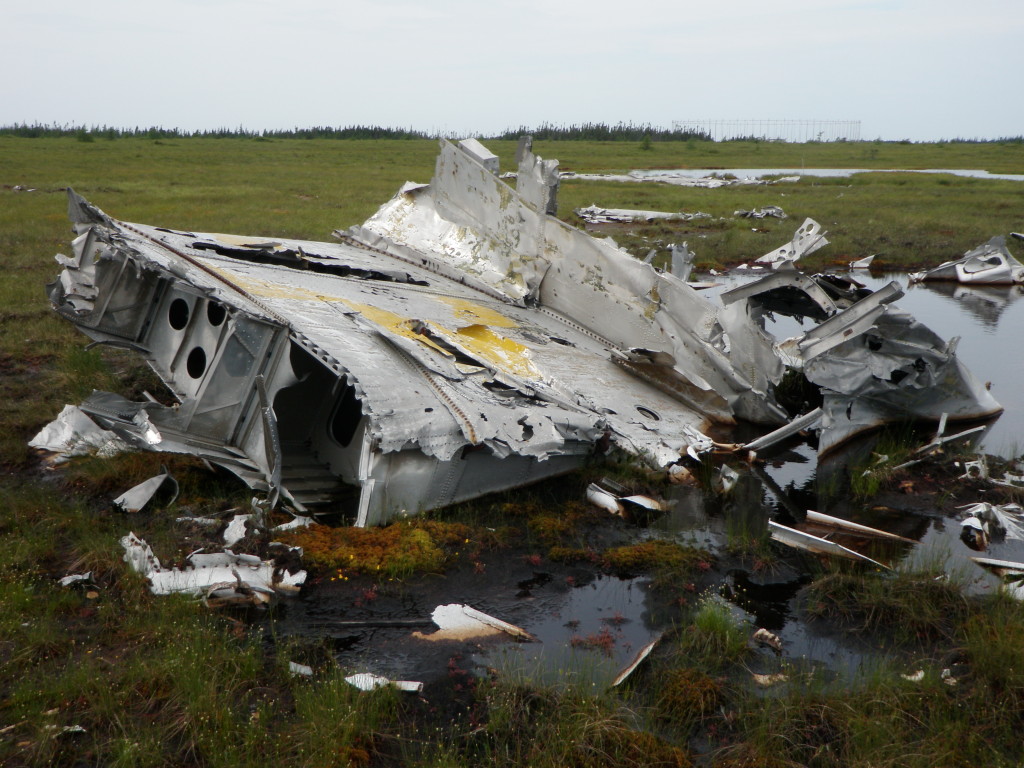
Perhaps the most notable thing about this site is how little it has changed since the crash.

OLYMPUS DIGITAL CAMERA

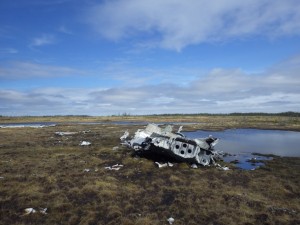
Some of the Digby that remains on the site. Note the similarity to the picture below. Photo by author, 2014.

Image of the RCAF Digby wreckage taken during the crash investigation. Note the similarity in the site picture from 2014 (above). From Heakes 1941.

Image of the RCAF Digby wreckage taken during the crash investigation. Note the similarity in the site picture from 2014 (above). From Heakes 1941.

At 1856 GMT on 24 July 1941, RCAF Douglas Digby 742 left Gander with a crew of six for the purpose of convoy patrols. At 2320 GMT the weather began to deteriorate and the Meteorological Office predicted that the ceiling would remain at about 1500 feet with showers. At 2326 GMT the aircraft was recalled, but Digby 742 did not immediately respond. The recall notice was repeated four times by Gander Station and twice by RCAF Station, Sydney. The recall was acknowledged at 0030 GMT and at 0151 GMT the aircraft was in range of the Gander airbase. Digby 742 was spotted by Airport Control, but the aircraft reported that it could not see the airport. By this time, the ceiling had deteriorated to 200 feet with rain and increased wind and the cloud had begun to blow across the runway. When Digby 742 arrived, RCAF Digby 756 was attempting to land at Gander and Digby 742 was instructed to circle until Digby 756 had landed. Digby 756 landed safely at 0219 GMT but for approximately the next twenty minutes, Digby 742 was out of communication range. Captain Tomsett was instructed to proceed to Dartmouth where the weather conditions were more favourable but the Captain stated that he would attempt to land at Gander one final time and would proceed to Dartmouth if that landing was unsuccessful. At 0310 GMT a loud explosion was heard and there was no further communication with the aircraft. At 0330 GMT, the ceiling began to steadily rise becoming 1400 feet by 0530 GMT (Heakes 1941).

Name Rank Serial Number Unit Duty Injuries
Tomsett, M.E. F/Lt. C.1069 10 (BR) Pilot Fatally
Mather, W.H. P/O J.3479 10 (BR) Pilot Fatally
Pratt, A.G. P/O 10 (BR) Navigator Fatally
Hunt, M.S. Sgt. R60720 10 (BR) Air Gunner Fatally
MacDavid, R.L. Sgt. R73032 10 (BR) Air Gunner Fatally
Crawford, T.J.E. AC 1 R65641 10 (BR) Wireless Fatally

Crew list for RCAF Digby 742. Adapted from Heakes 1941

At first light, two aircraft were dispatched to search for Digby 742. The wreck was located almost immediately after take-off and a ground party which had been organized during the night was sent out to the scene of the accident. F/L MacLennan, Medical Officer at the RCAF Station Hospital, was in the ground party and assessed the injuries of the crew. The bodies were located throughout the site, and in some cases were thrown as far as 240 feet from the main wreckage. All of the crew except Sgt. MacDavid died instantly; MacDavid succumbed to his injuries shortly after the accident. All crew were found to have extensive injuries, and in all cases except for AC 1 Crawford, showed fractures to the skull and long bones. Crawford sustained massive trauma to the abdominal and thoracic areas, causing death. When the crew were examined they were all in a state of rigor mortis (Heakes 1941). As a result of this crash, it was believed that there would be further casualties in Gander, so an area was selected for the Commonwealth War Graves and these airmen were the first RCAF crew to be buried in Gander (Heakes 1941; Pattison 1941; Walker 2002).

Map of the debris field. Daly 2015.

Map of the debris field. Daly 2015.

The accident report gives the evidence that the aircraft came in too low and the starboard wing struck the bog, resulting in the crash. It states:

From the furrow out in the ground it appears that the starboard wing tip struck the ground after which the aircraft cartwheeled resulting in the wing, nose and engines being torn from the fuselage and the fuselage breaking in the centre behind the bomb-bay (Heakes 1941).

Where the wing struck the bog in 1941 is still visible. Note the debris in the scar. Photo by author, 2010.

Where the wing struck the bog in 1941 is still visible. Note the debris in the scar. Photo by author, 2010.

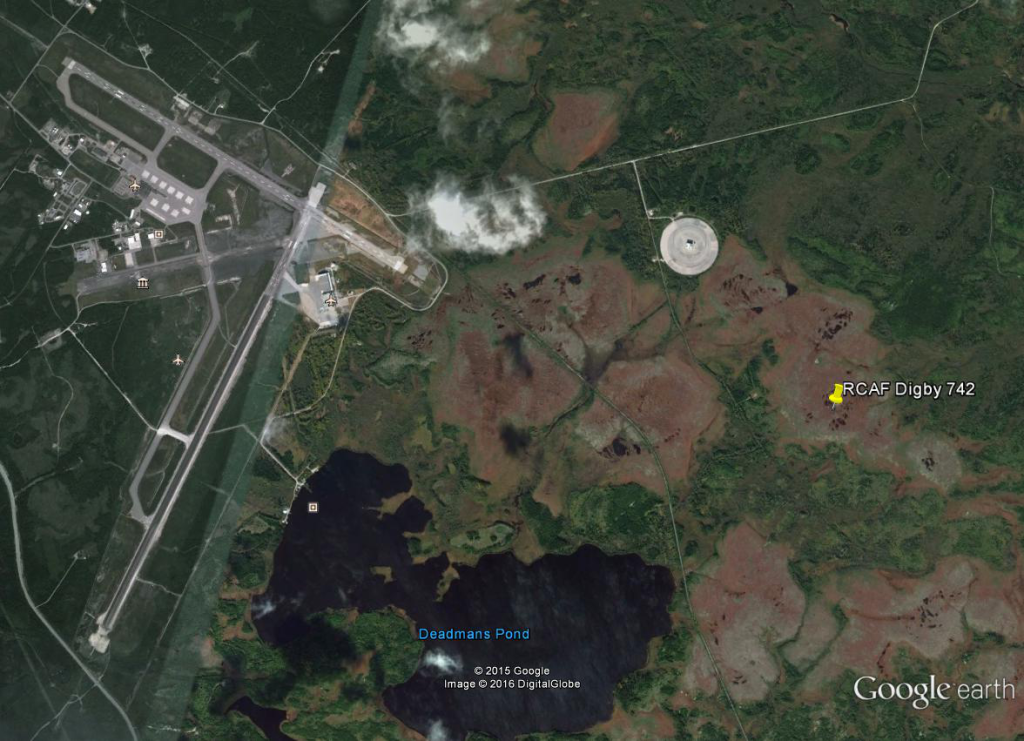
The archaeological map of the site agrees with this assessment. The scar where the wing tip struck is still visible and does contain some aircraft debris. The artifacts in the scar could not be measured accurately to be placed on the map because while the whole area is unstable, the areas that were damaged in the crash are much too unstable to walk on. The wings are to the northwest of the impact point, and the tail is partially submerged to the east of the impact point. The cockpit was not visible and may have been destroyed by investigators or sank through the bog. One piece in an open area of water could not be measured in the field and was measured from GoogleEarth images. This piece, which looked like a section of engine cowling, is approximately 260 feet (75 meters) from the main area of wreckage: the tail and rear end of the fuselage. This could be approximately where the bodies of P/O Pratt and AC 1 Crawford were located as the witness statement states:

I was shown the body of P/O Pratt. The body was 240 feet from the main wreckage, body partly submerged in a small pond, face and head above water. […] I was shown the body of AC 1 Crawford, T.J. The body was 220 feet from the main mass wreckage and was attached to seat [sic]. It was found in the small pond with head submerged in water (Heakes 1941).

Approximate location of the wreckage. Google Earth.

Approximate location of the wreckage. Google Earth.

The engines were in good condition prior to take-off and the aircraft had passed inspection. The altimeter settings had been passed on to the aircraft more than once, but Digby 742 never acknowledged receiving them. Salvage of the aircraft was requested, but given that the engines and bombs had sunk beneath the bog, Eastern Air Command in Halifax determined that the salvage values of the engines would not warrant the expenditure necessary to drain the bog to retrieve them. Similarly, due to the boggy nature of the area, it was believed that the six-hundred-pound live bombs from the aircraft would soon rust through to become inert and up to that point the area should be treated with caution. Until the bombs were determined to be inert, it would be unsafe to attempt salvage operations, especially of the engines (Heakes 1941).

Excerpt from the 1941 crash report discussing the viability of recovering the engines. From Heakes 1941.

Excerpt from the 1941 crash report discussing the viability of recovering the engines. From Heakes 1941.

Although weather conditions had deteriorated, at this time there were no regulations for minimum ceiling. The conditions that were present at the time of the crash were poor and landing should only have been attempted by an experience pilot. As a result of this crash, recommendations were made to the RCAF to put in place regulations for landing in poor conditions based on the time of day (day or night flying) and the experience of the pilot; an experienced pilot is considered to have completed at least 300 hours of flying on that specific type of aircraft. The determination that weather conditions are poor would be based on the ceiling level and at the discretion of the Aerodrome Control Officer (Heakes 1941).

Based on images taken after the initial accident compared to the site in 2010 and 2014, it looks as if the wreckage has been relatively untouched since the incident. The major change visible is a slow settling and sinking of the aircraft into the bog. As well, the different times of year will make the site look different depending on the amount of recent precipitation.  As stated in the incident report, the heavier items, such as the engine and the bombs sank under the bog before investigators reached the site, so the assumption can be made that any other heavy pieces of the aircraft, especially those with a small surface area, sank as well. What does remain are essentially pieces of aluminum of varying sizes (from small fragments of a few inches to a large wing section) “floating” on the bog. This does leave the site relatively intact since the crash, and thus allows for a better idea of the crash mechanics (Young 2014). As seen above, the crash report was detailed regarding the mechanics of the crash, and looking at the site it is possible to see the site similarly to how it was seen in 1941. In this case, the incident report has been able to inform the researcher and point out other areas, such as the engine cowling in a nearby area of open water, where debris can be found. This makes this site one of the most intact in the Gander area that has so far been examined by archaeologists.

What remains of the wings, "floating" on the bog. Photo by author, 2010.

What remains of the wings, “floating” on the bog. Photo by author, 2010.

That said, there is evidence that people have visited the site.  As is typical for known crash sites, a yellow X was painted on one of the larger pieces of wreckage. Names and dates of site visitors have been scratched into that paint. The majority of these names date between 1961 and 1968 and between 1983 and 1999. The Circularly Disposed Antenna Array (CDAA) was opened in 1970, which most likely prevented access to the site (RCAF 2009). According to staff at the facility, the antenna near the crash site was inactive in the 1980s and erected again in 2000, making the easiest access route to the crash site a restricted area (Fudge 2010). In fact, this researcher had to be escorted through the boundaries of the CDAA to gain access to the site. Because the site is still in operation, there is limited information about the area except that it is restricted.

Graffiti on the aircraft wreckage. Photo by author, 2010.

Graffiti on the aircraft wreckage. Photo by author, 2010.

While this site can be accessed by other routes, it is not recommended as the site is unstable, especially near the debris and the scar from where the wing struck, and visitors are at risk due to the unstable nature of this bog (Hillier 2010). In fact, which investigating the site, even walking near a fragment of aircraft could cause it to shift on the landscape. As well, according to a bomb disposal expert with the Royal Newfoundland Constabulary, caution should still be taken on site until the time that the status of the bombs can be determined (Deacey 2011). The incident report believed that the bombs would be deactivated as they would rust through in the bog, but this may not be the case as bogs are environments that can actually preserve materials rather than destroy them.

Some of the Digby that remains on the site. Photo by author, 2014.

Some of the Digby that remains on the site. Photo by author, 2014.


References

Daly, L.
2015      Aviation Archaeology of World War II Gander: An Examination of Military and Civilian Life at the Newfoundland Airport. Doctoral (PhD) thesis, Memorial University of Newfoundland.

Deacey, C. (RNC)
2012      Personal Communication

Fudge, M. (CAF)
2010      Personal Communication

Heakes, F.V.
1941      Douglas Digby Aircraft No. 742 Fatal Accident to Above at Newfoundland on 25-7-41. Department of National Defence – Canada RCAF, Gander, Newfoundland.

Hillier, D. (Newfoundland aviation historian)
2010      Personal Communication

RCAF (Royal Canadian Air Force)
2009      9 Wing Gander: History. http://www.rcaf-arc.forces.gc.ca/9w-9e/page-eng.asp?id=509 (accessed 28 Aug 2012).

Pattison, H.A.
1941      Letter to the Secretary for Public Works 10 February 1941. On file, Provincial Archives of Newfoundland and Labrador, GN Box S5-5-2.

Walker, R.W.R
2012      Canadian Military Aircraft Serial Numbers, http://www.ody.ca/~bwalker/index.htm (accessed 13 Sept 2012).

Young, D. (Aircraft maintenance engineer)
2014      Personal Communication