WWII

All posts tagged WWII

I’m not thrilled to be posting two book reviews in a row, but I took this one and Under The Radar by Tom Drodge out of the library at the same time, and I thought it best to do the review before I have to return them. Hopefully I will have something more exciting for next week.

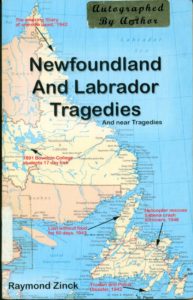
Newfoundland And Labrador Tragedies: And near Tragedies by Raymond Zink is a self-published work that looks at five exciting events in Newfoundland and Labrador. Of course the aircraft incidents caught my eye. The events are around two students from Bowdoin College who end up taking 17 days to get from what is now Churchill Falls down the Grand (then Hamilton, now Churchill) River to safety in 1891, the Truxtun and Pullux disaster of 1942, the 1942 Saglak Bay crash, Ranger Hogan’s 50 day survival after bailing out of a Ventura in 1943, and the 1946 Sabena crash near Gander.
scan0001

This is an incredibly interesting book for anyone not familiar with these events. There are stories of extremes of human survival, even if in some cases the people did not survive. Those in the Saglek Bay crash survived for at least 55 days in the middle of winter (10 December 1942 to the last diary entry on 3 February 1943) before starving. Even when they were found, it was noted that they did not freeze to death, which shows an impressive level of survival skill.

I did not know about the Bowdoin College students who were send up the Grand River to document the falls, nor that there is a canyon named after them. I certainly did not know about their ordeal trying to get back down the river. Four students started the journey, but two turned back after one injured his hand. The other two made it to the falls, but lost much of their supplies due to a fire and had to walk back down the river to the meeting point. For most of the walk they survived off squirrels that they shot. For this reason, I found this entry to be the most interesting.
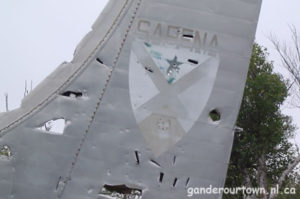
Sabena wreckage. From http://www.ganderourtown.ca/zOld/PhotoSabena.htm.

Sabena wreckage. From ganderourtown.nl.ca.

The reason why I did not find the other events as interesting is that the author does not really bring anything new to the stories. I was familiar with them, and have read the Saglek Bay “Diary of one now dead”, read not only Frank Tibbo’s Charlie Baker George about the Sabena, but also the reports that are found in the Provincial Archives of Newfoundland and Labrador. Similarly, I have read about Ranger Hogan’s experience both in the archives and in books about the Newfoundland Rangers. The Truxtun and Pollux disaster has been in the news relatively recently with the death of Lanier Phillips and his story gaining interest in the United States.
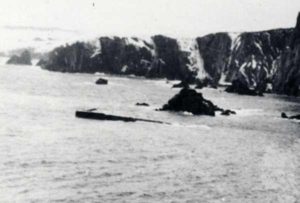
Wreck of the USS Truxton. From http://www.originalshipster.com/2014/09/30/over-the-waves-uss-truxtun/

Wreck of the USS Truxton. From originalshipster.com.

Zinck’s style mainly consists of copying newspaper, diaries and reports verbatim to let the reader see the story. In some cases he does add information, but typically it is commentary such as the fact that the two trappers, Bruce Shea and Abbott Pelley, who were instrumental in helping survivors in the first night after the crash, were not recognized for many years for their involvement. He also makes commentary on the fact that those who crashed in Saglek Bay did not take advantage of the fact that they had gun and could have hunted (the diary entries talk about fox and seals nearby) and relied only on the food they had on board the aircraft. That is valid commentary, but I don’t understand why, when talking about Ranger Hogan and Corporal Butt, Zinck starts to talk about the fat content of porcupines and how they are great as survival food, then states that there were neither porcupines nor squirrels in Newfoundland at the time. Hogan and Butt were in the woods for 50 days with no provisions and survived off of 12 rabbits and whatever berries, leaves and greens Hogan could find. I did learn about the Hogan Trail, and have been wanting to get back to the Northern Peninsula, and will be sure to walk this commemorative trail when I do.
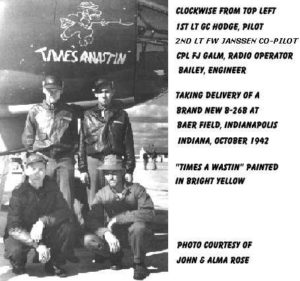
Crew of the B-36 Times A'Wastin' which crashed in Saglek Bay. From http://lswilson.dewlineadventures.com/page8.htm.

Crew of the B-36 Times A’Wastin’ which crashed in Saglek Bay. From A Crash In the Wilderness

And, as usual, there are the editing problems that often accompany self-publication. In some cases, Zink is inconsistent in the spelling of places. The book is littered with typos and formatting issues, and like the porcupine comments, there are odd tangents which do not add to the telling of the events.

If you haven’t heard about some of these events in Newfoundland and Labrador history, then this is a great book to pick up. But if you are familiar with them, then give it a pass.

Zinck, R.G.
2009  Newfoundland And Labrador Tragedies: And near Tragedies. Publish Yourself: Halifax.


The full report for this Royal Air Force Ferry Command flight is not available. That said, two of the crew on board were members of the Royal Australian Air Force so there is crash information available in the file associated with the pilot P/O Ronald George Stanley Burrows (RAAF 1942).

Table 1: Crew list for RAF Hudson FK690. Adapted from Christie 1995 and RAAF 1942.

Name Rank Serial Number Service Duty
Burrows, Ronald George Stanley P/O 401898 RAAF Pilot
Simmons, Douglas Percy Charles Sgt. 1334966 RAF Pilot
Thomson, Graeme Hamilton P/O 656086 RAF Navigator
Fazel, Jack Eric Sgt. 405399 RAAF Radio Operator

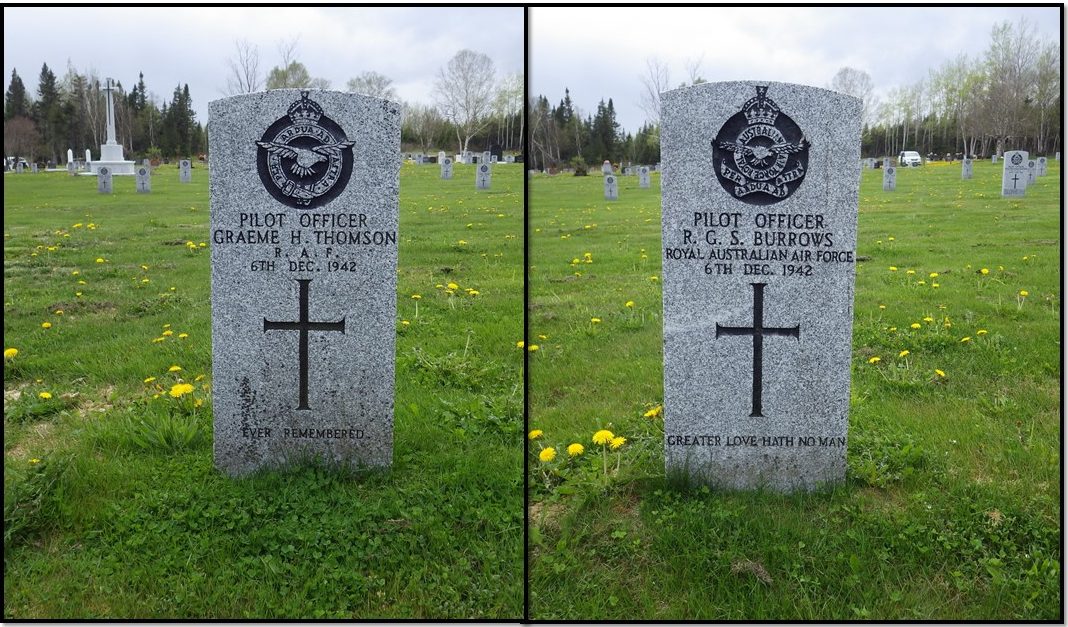
Ferry Command Hudson Mk. VI s/n FK 690 crashed on 6 December 1942 at 0351 GMT, one minute after takeoff. The aircraft was beginning a Ferry Command delivery flight to the United Kingdom, but stalled after takeoff, crashed and burned, killing all four crew on board (Table 1; Christie 1995; RAAF 1942). A funeral service was held at 1700 GMT and the victims were all buried in the Commonwealth War Graves in Gander on 7 December 1942 (Figure 1; RAAF 1942).

Figure 1: The graves of RAF P/O Graeme Hamilton Thomson and RAAF P/O Ronald George Stanley Burrows at the Commonwealth War Graves in Gander. Photo by author, 2014.

Figure 1: The graves of RAF P/O Graeme Hamilton Thomson and RAAF P/O Ronald George Stanley Burrows at the Commonwealth War Graves in Gander. Photo by author, 2014.

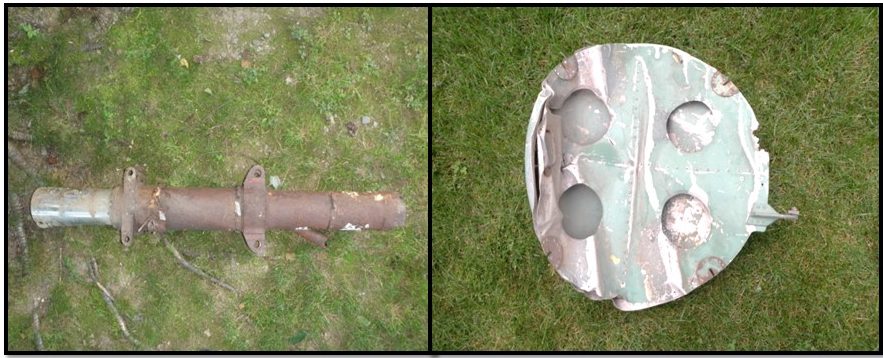
There is very little left to this site, mostly due to the fact that the Trans-Canada Highway was planned to pass over the wreckage. As such, people from Gander were encouraged to visit the site and take pieces of the aircraft as souvenirs or scrap. Some of these pieces are still in the possession of people around Gander, and some were kind enough to allow me to photograph what they had (figure 2).

Figure 2: The hydraulic and tank cover collected my Mr. Connors of Gander when highway construction threated the crash site. Photo by author, 2010.

Figure 2: The hydraulic and tank cover collected my Mr. Connors of Gander when highway construction threated the crash site. Photo by author, 2010.

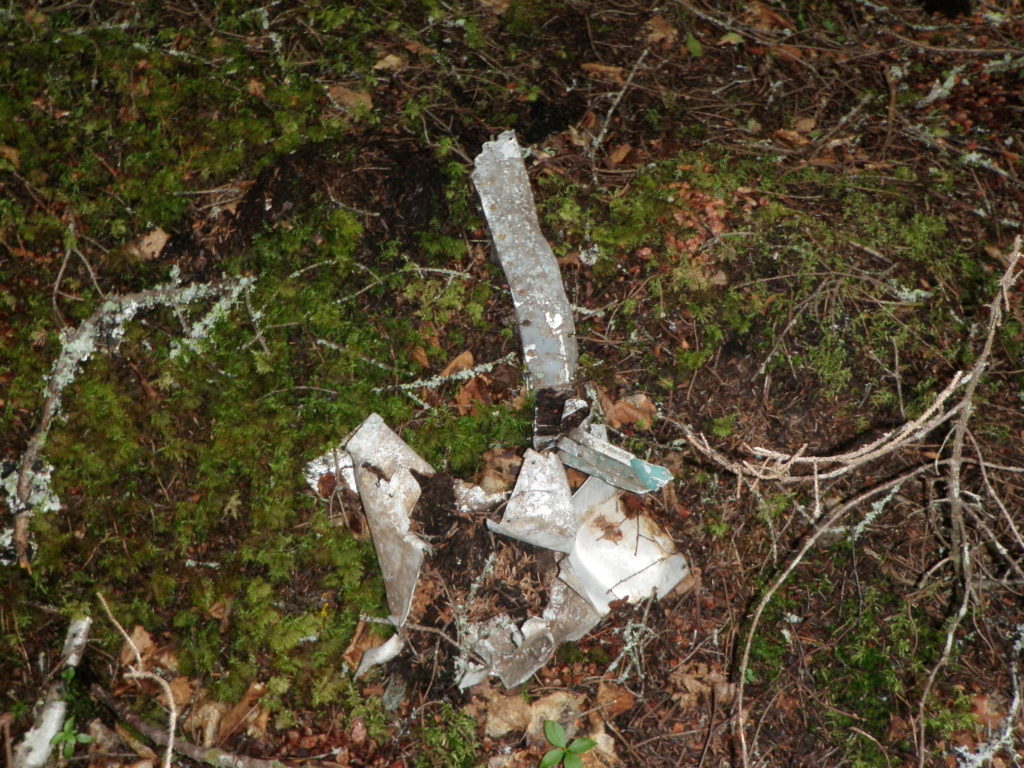
The highway did not pass directly over the site, but the road to the War Graves does potentially pass over some of the wreckage. When visiting this site, I was told that some pieces were on either side of the road, including a landing gear east of the road. Looking through thick alders, my team could not find the landing gear or any other evidence of wreckage east of the road, but did find some small pieces west of the road (figure 3). That is not to say that the landing gear isn’t still on the site, just that I could not find it.

Figure 3: Some of the wreckage that remains on site. Photo by author, 2010.

Figure 3: Some of the wreckage that remains on site. Photo by author, 2010.

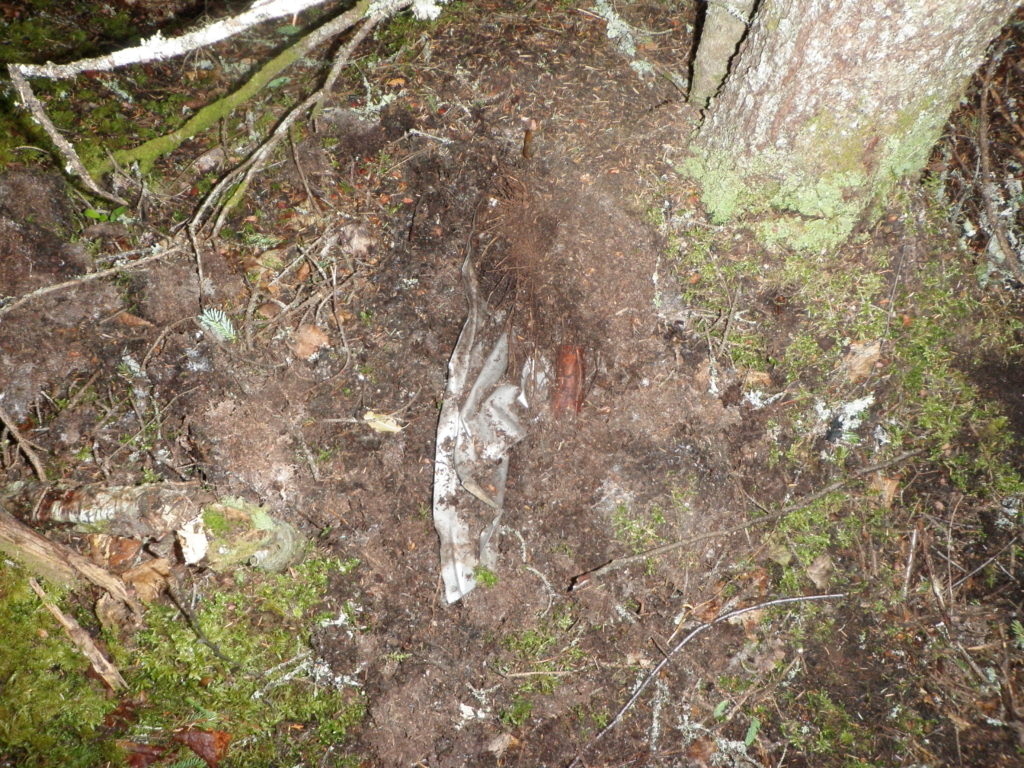
My team also used a metal detector to see if there was much under the surface of the area. Only a couple of small pieces were found and positively identified as aircraft wreckage. Some of the hits closer to the highway were simply litter (figure 4).

Figure 4: With the use of a metal detector, more aircraft fragments were uncovered in 2011. Photo by author, 2011.

Figure 4: With the use of a metal detector, more aircraft fragments were uncovered in 2011. Photo by author, 2011.

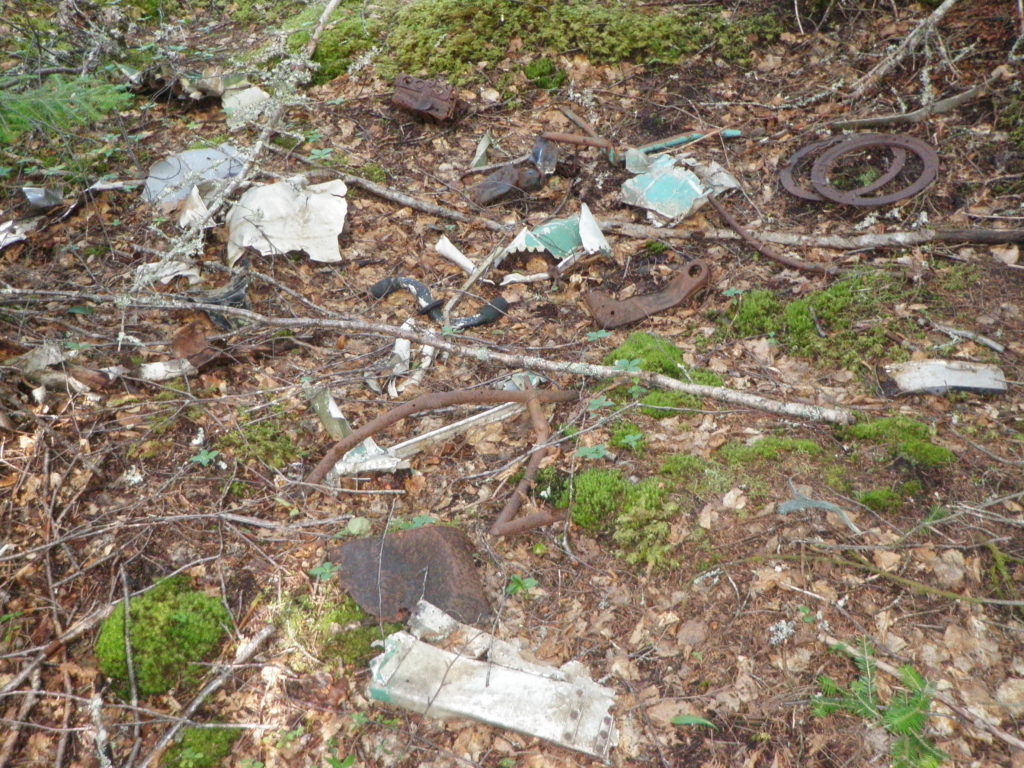
As there is so little left to this site, very little further information about the crash can be found through the analysis of the material culture. Also, how the objects were removed from the site is a little different from other sites. Sites that are stripped of scrap metal tend to be very distinct in what remains. Objects that are too heavy to transport, that are heavily rusted, or that contain materials that cannot be easily recycled in Newfoundland (like steel), tend to remain on site. Those pieces are also left in situ as there would have been no need to move them. But, as people were encourage to take whatever they found interesting, what remains are very small pieces that were potentially moved and gathered together in an effort to encourage their removal (figure 5).

Figure 5: Area of highest artifact concentration on the site. Photo by author, 2010.

Figure 5: Area of highest artifact concentration on the site. Photo by author, 2010.


Sources:

Bryan, C.
2010    Personal communication, Gander resident.

Christie, C. A.
1995    Ocean Bridge: The History of RAF Ferry Command. University of Toronto Press, Toronto.

Hillier, D.
2010    Personal communication, historian.

Leahy, D.
2012    Lockheed Hudson Mk. VI FK 690. RAAF Casualty Database, http://www.raafdb.com/ , accessed 10 May 2016.

RAAF (Royal Australian Air Force)
1942    4018988 F/O R.G.S. Burrows. Royal Australian Air Force, Canberra. On file, National Archives of Australia, A705 163/24/355.

Site wreckage

Site wreckage